From low Earth orbit to the red plains of Mars, humanity’s next frontier is about more than exploration — it’s about building life beyond Earth. What will it take to make that possible?
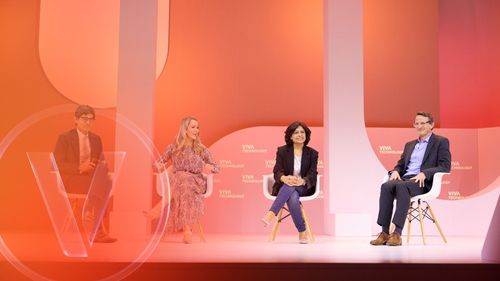
At VivaTech 2025, three innovators shared their vision for a sustainable off-world future. Barbara Belvisi, founder and CEO of Interstellar Lab, develops bioregenerative habitats that can grow food and recycle air in space. Drew Feustel, former NASA astronaut and Chief Astronaut at Vast, is helping design the first commercial space stations. Lucie Campagnolo, CEO of SpaceFounders France, supports the deep-tech startups behind these breakthroughs.
Building Life Beyond Earth
For Feustel, the future of space isn’t about simply reaching orbit — it’s about staying there. Vast’s upcoming Haven-1 station, due to host its first crew in 2026, aims to do exactly that. Highly automated systems will let astronauts spend more time on science and less on maintenance, opening spaceflight to a wider range of missions and nations.
The next big step isn’t just getting to space,” Feustel said. “It’s learning how to live there.
Belvisi’s vision complements that mission. At Interstellar Lab, she’s developing AI-controlled biospheres that recreate Earth’s ecosystems in miniature — using plants and microbes to generate oxygen, recycle water and produce food.
Humans need water, oxygen, and food,” Belvisi explained. “And when it comes to bringing things in space, you want to bring less and recycle more.
Her bio-regenerative systems turn natural processes into life-support technology that could one day sustain astronauts on the moon and Mars — while advancing sustainable agriculture here on Earth.
The Invisible Ecosystem Behind The Stars
While the conversation touched on rockets and habitats, Campagnolo reminded the audience that the future of space is also being built quietly in labs and workshops across Europe. As head of SpaceFounders, the venture arm of France’s national space agency, she scouts emerging startups whose components, sensors and solar systems underpin the industry’s biggest ambitions.
Everything that has been presented in this movie cannot be achieved without a lot of small and interesting projects — components, semiconductors, solar panels.
Her message was a practical one: large-scale missions only succeed when the entire value chain is strong. “We detect all over Europe new startups, innovation, technologies that can have an application for the space industry,” she explained. “And this is something that’s sometimes forgotten in the space endeavor.”
Campagnolo added that venture investors must learn to see risk differently — that real progress in space demands patience and courage.
“It’s our role to take the risk — to help the innovation and not look at those projects with a very analytical eye, because it’s different… it’s an environment that has been untested.”
The Human Element
Even with all the new technology, the panelists kept returning to one essential truth: space exploration is ultimately a human story. Feustel reflected on how automation is reshaping astronaut training — shifting the focus from survival to science.
We’ve automated a lot of the complex tasks,” he said. “So that allows us to reduce the training flow and allows astronauts to focus more on the experiments and the research. That actually is what makes the spaceflight meaningful.
On the International Space Station, an astronaut needs roughly five kilograms of supplies a day. As every kilogram of cargo costs thousands of dollars to launch, nothing is wasted. But for Belvisi, sustainability is about more than logistics. Her biospheres are designed not only to recycle resources but to support the mental wellbeing of astronauts in isolation.
She recalled stories of astronauts growing plants in secret, hidden from NASA’s cameras, and competing to see whose kale would grow fastest. A reminder that life adapts even in space.
As Belvisi explained, her goal is to bring a piece of Earth into orbit — to let natural processes, not just machines, do the work.
The Decade Ahead
With the International Space Station set to retire around 2030, companies like Vast are preparing to keep humanity in orbit — and lay the groundwork for the Moon and Mars. The speakers closed with predictions that captured both the ambition and optimism of this new era: a rose blooming on the moon, a leap in nuclear propulsion, and the first woman setting foot on the lunar surface.
The message was clear: expanding humanity’s reach into space isn’t escapism — it’s a testbed for innovation that can also help life on Earth.
Interested in more space exploration? Check out this article: How Space Tech is Powering Climate Innovation