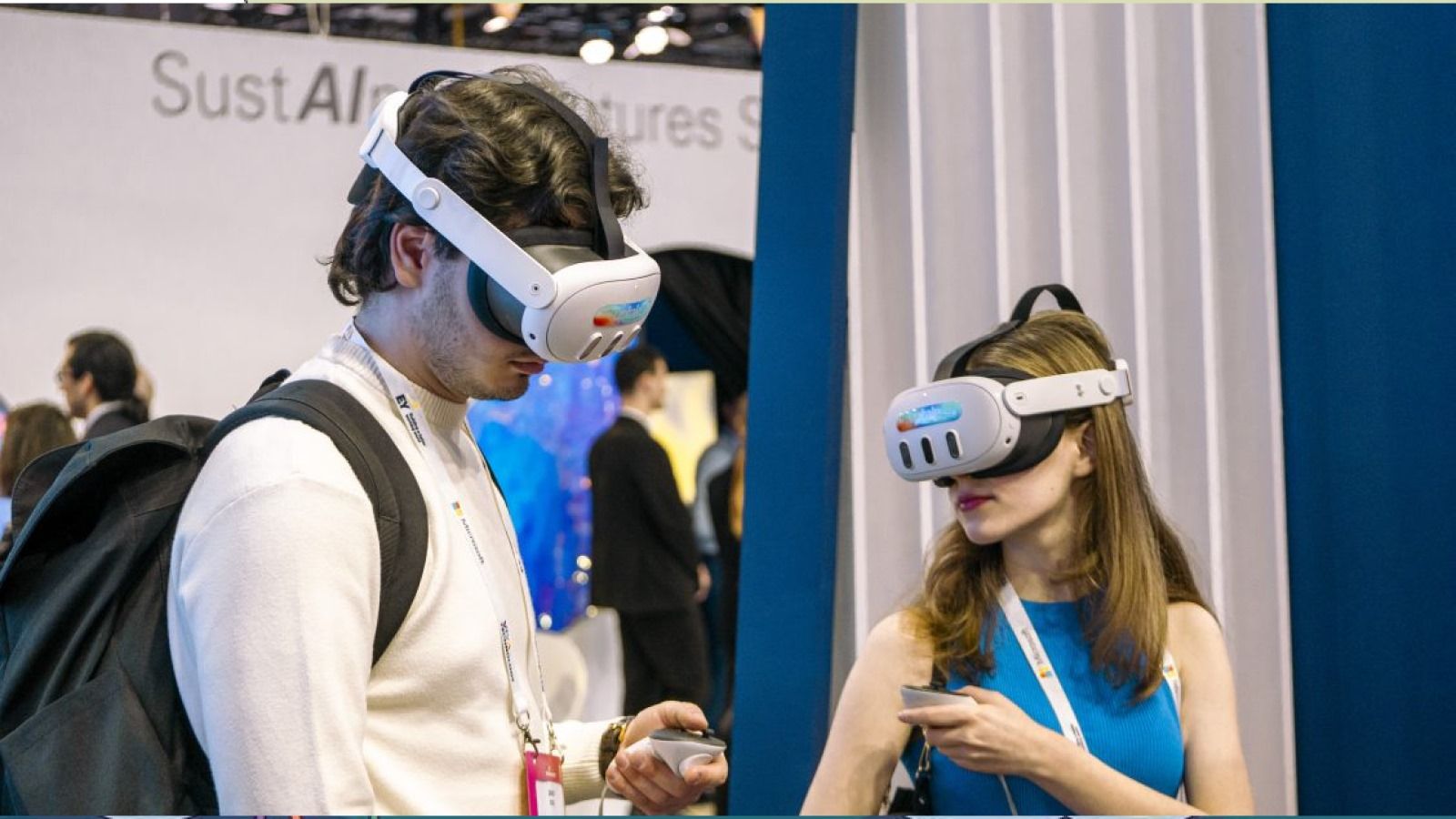
If traditional skills training feels like reading a manual, Uptale’s VR learning is like stepping directly onto the job site.
Founded in 2017, the French startup has built an immersive learning platform that allows enterprises and organizations to create virtual reality training without the need for developers. Instead of watching videos or memorizing procedures, learners are placed inside realistic, high-stakes environments where they have to act, decide, and learn from their mistakes.
That shift from passive learning to lived experience has made Uptale one of the most exciting VR companies in Europe today, helping it raise €9 million in its latest funding round. And VivaTech has played a central role in that journey.
Uptale’s Immersive Learning Changes the Game
Uptale’s core promise is that anyone can create VR training as easily as a PowerPoint presentation.
"Uptale is an immersive learning platform that allows larger organizations to create, scale and deploy 360° VR trainings with no technical skills,” explains Dwayne Iserief, one of Uptale’s four co-founders.
Wearing a VR headset (or using a laptop or smartphone), users are placed inside real-world scenarios such as working on railway tracks, giving medication to a hospital patient, or navigating industrial safety situations. Instead of just being told what to do, they have to do it themselves.
You’re able to make decisions and make mistakes,” Iserief says. “And that’s all in a digital format that looks like you are in the field.
At a time when many startups focused on the novelty of VR technology, the Uptale team searched for real-world applications. “Our fourth co-founder worked at an insurance company, and she had a first use case to get people immersed in the reality of the field. That rang a bell.”
Uptale’s immersion approach was captivating, but it wasn’t what ultimately set them apart from the competitors. “Our real differentiation is to have a platform to create and deploy those types of trainings. Our clients become totally autonomous. They create content by themselves like a PowerPoint.”
They had a stellar product, but needed to get the attention of large organizations looking to scale learning globally. That’s where VivaTech stepped in.
First Demo at VivaTech to Industry Validation
Uptale’s relationship with VivaTech stretches back nearly a decade, not long after the company’s founding.
The first time, we were still at Station F,” says Iserief. “We had a small area for half a day in the booth of one of our partners, Microsoft.
At that stage, Uptale’s goal was simple: let people test out the product. “We were demonstrating what the technology could do when people were wearing the headset [and they would say], ‘Oh my God, this is the technology? I never used VR headsets.’”
Fast forward to recent editions of VivaTech, and the picture looks very different for Uptale. “Last year we were at five different booths of clients [including] CMA CGM, Sanofi and PwC. We were demonstrating real use cases, what we were doing at scale with them.”
Turning Buzz into Business Value
What made VivaTech especially valuable for Uptale was access to decision-makers who could then see the startup’s proven results for themselves.
Executive C-levels from other business units were discovering real, effective use cases deployed among their organization,” explains Iserief. “That was a real differentiator.
Instead of explaining what VR could do, Uptale was showing what its technology was already achieving in industries as diverse as rail, manufacturing, luxury, and pharmaceuticals.
This changed the types of conversations happening at VivaTech. “Last year it was really interesting for us, shifting from showing the technology or the potential, to having business conversations about how we could deploy a new use case and how we could scale the initiative.”
For a B2B startup, that transition from piqued interest to business replication is a huge marker of success.
The Most Represented VR Startup at VivaTech
Today, Uptale is the most represented VR startup at VivaTech, with its technology showcased across multiple partner and enterprise booths.
That visibility is a testament to both its platform’s flexibility, and its credibility. When companies like SNCF and Engie choose to include Uptale’s technology as part of their own VivaTech presence, it signals trust in the product.
For Uptale, VivaTech’s value is now in reinforcement – the ability to prove that immersive learning is no longer experimental, but an operational solution useful for a wide variety of companies and industries.
Uptale’s Vision for AI-Powered Learning
Looking ahead, Uptale is focused on how immersive technology can merge with artificial intelligence.
With AI, we are able to provide a customized journey to everyone,” says Iserief. “Every learner will be able to get immersed and to get into reality with customized advice.
As VR headsets become lighter, more accessible, and more realistic, Uptale also envisions fully immersive digital twins. “The combination of AI and immersive technology is really creating digital twins, where everybody can train safely and be able to have a customized environment where they can evolve.”
What began as a small demo in a partner booth at VivaTech has matured into a platform that’s shaping the future of workforce training.
What to see how VR technology can change how you work and learn? Come experience for yourself at Vivatech 2026.


