 Businesses are using different AI models to solve very different problems—from forecasting customer demand to generating marketing copy and writing software code. Understanding the strengths of generative AI vs predictive AI helps leaders choose the right solution for their companies.
Both approaches are based in machine learning and data, but predictive AI identifies patterns in data to forecast future outcomes, while generative AI creates new content.
The key question is which technology best suits the challenge you're trying to solve, and whether the strongest competitive advantage could actually come from combining both.
What Is the Difference Between Generative AI and Predictive AI?
The simplest way to understand generative AI vs predictive AI is to look at their outputs.
Both rely on machine learning models trained on large datasets, but their objectives differ:
- Generative AI creates new outputs. Given a prompt, it produces text, imageS, software code, video, music, or other forms of content based on patterns learned during training.
- Predictive AI forecasts future outcomes. Predictive AI doesn't create content. It analyzes existing data to predict what is most likely to happen next. It can forecast things like customer churn, equipment failure, fraud, sales demand, or inventory requirements.
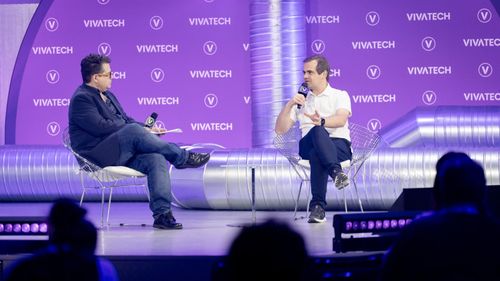
How easy they are to use is another differentiator, as Victor Riparbelli, CEO and co-founder of business AI video platform Synthesia, pointed out on stage at VivaTech 2026:
What is different about generative AI compared to predictive AI—a big part of it is the accessibility,” he said. “Previously, you'd have to collect the dataset, train the models, take a very long time before you even know if whatever you're trying to do actually worked and how well it worked. Today, with tools like ChatGPT, Synthesia, StableDiffusion, you can go in, and in literally five or ten seconds, you can discover for yourself how powerful these things are.
How Generative AI Works
Generative AI models learn statistical relationships within enormous datasets during training. They learn patterns, language structures, visual relationships, and coding logic that allow them to generate new outputs when prompted.
Large language models (LLMs) are probably the best-known examples of generative AI. Models like ChatGPT, Claude, and Gemini can generate human-like text, summarize documents, answer questions, draft emails, write software code, and assist with research.
Large language models (LLMs) are probably the best-known examples of generative AI. Models like ChatGPT, Claude, and Gemini can generate human-like text, summarize documents, answer questions, draft emails, write software code, and assist with research. Image generation models such as GPT Image 2, Midjourney, and FLUX 2 can create visuals from text prompts, while other specialized models can produce music, videos, or synthetic data for testing applications.
How Predictive AI Works
Predictive AI focuses on forecasting. It uses historical data to identify patterns that help predict future events. The more high-quality data is available, the more accurate predictions typically are. Predictive AI is generally used to produce probabilities, classifications or rankings.
For example, these models can:
- Calculate the probability that a customer will cancel a subscription
- Estimate next month's product demand
- Identify transactions likely to be fraudulent
- Predict when industrial equipment will require maintenance
XGBoost, Random Forest, and Prophet are among the most popular predictive AI models, though they are lesser known to the general public than generative AI models.
Where Generative AI Delivers the Most Business Value
Generative AI is rapidly changing knowledge work across industries by helping employees create content faster and automate tasks.
Content Creation and Customer Engagement
Marketing teams were among the earliest adopters of generative AI, using the technology to help draft blog posts, advertising copy, product descriptions, social media content, email campaigns, customer support responses, and personalized recommendations.
Generative AI also allows companies to expand their content creation into formats that were previously too expensive or difficult to produce.
If you take the online economy today, it's very obvious that people want to watch and they want to listen to content,” says Riparbelli. “People don't want to read that much anymore. And businesses have for many years been struggling with producing video content, producing audio content, because it's just not scalable. What we're seeing really is a general up-leveling of all the text in a company that can now become video. Now they can make video in 120 different languages. The information retention is much higher. But the unlock here is that this is something that everyone can do.
Customer service also benefits from AI assistants that generate natural language responses, summarize conversations, and provide agents with suggested replies.
Philippe Botteri, a partner at the venture capital firm Accel, told the VivaTech audience about a generative AI customer engagement use case that stood out to him: “One company was actually using the avatar of their CEO to send a personalized message to every customer,” he said. “So suddenly you're a customer, you buy the product, and you have the message from the CEO saying, ‘Hey, Mr. Jones, thank you very much for buying our product.’ And even though it is a synthetic video, it really has an impact on the customer.”
Accelerating Development and Operations
Software development is another major application for generative AI.
AI coding assistants can help developers generate boilerplate code, explain existing codebases, identify bugs, suggest optimizations, and accelerate testing.
Across operations, generative AI can also summarize internal documentation, generate reports, draft meeting notes, and support employee knowledge management.
Where Predictive AI Delivers the Most Business Value
Predictive AI has been creating business value for decades by reducing uncertainty and supporting better decisions.
Forecasting Demand and Revenue
Retailers, manufacturers, airlines, logistics companies, and financial institutions rely heavily on predictive AI models. Forecasting demand helps these businesses optimize inventory, reduce waste, improve staffing decisions, and anticipate supply chain disruptions.
For example, predictive AI can be used by:
- Financial organizations to estimate credit risk, forecast market behavior, and improve pricing strategies.
- Sales teams to prioritize leads based on the likelihood of conversion.
- Subscription businesses for predicting customer lifetime value and potential churn.
Predictive AI allows organizations to be proactive instead of only reacting to events after they happen.
Reducing Risk and Downtime
Risk management is another core strength of predictive AI. For example:
-** Manufacturers** monitor equipment using predictive maintenance models that identify likely failures before costly breakdowns occur.
- Banks detect fraudulent transactions by identifying unusual behavioral patterns.
- Healthcare organizations predict patient risks to improve treatment planning.
- Cybersecurity teams identify abnormal network activity before attacks escalate.
In each case, predictive AI reduces operational uncertainty by turning historical patterns into actionable insights.
Can Generative AI and Predictive AI Work Together?
Business can get the most out of the technology by combining generative AI and predictive AI to improve both decision-making and execution.
Combining Forecasts with Content at Scale
Predictive AI identifies what should happen next. Generative AI helps teams act on those insights.
Used together, prediction drives strategy while generation accelerates execution.
Say a predictive model identifies the customers most likely to cancel a subscription. Generative AI can then automatically create personalized retention emails tailored to each customer's case.
A Practical Example: Demand Forecasting Meets Personalized Marketing
Let’s imagine the case of a retailer preparing for the holiday shopping season.
The retailer can use predictive AI to analyze historical purchasing data, weather patterns, promotions, and economic conditions to forecast which products will experience the highest demand.
Marketing teams can then use generative AI to create personalized email campaigns, landing pages, advertisements, and product recommendations targeted to different customer segments.
The predictive model determines where the opportunity exists. The generative model helps capitalize on it at scale.
This combination illustrates why many organizations no longer view generative AI vs predictive AI as an either-or decision.
How to Choose the Right Approach for Your Business
Technology should never drive strategy. Instead, you should begin with the problem you need to solve.
Start with the Business Problem, Not the Technology
First, ask what outcome you're trying to improve. If the challenge involves forecasting future events—such as customer demand, maintenance schedules, fraud detection, or financial performance—predictive AI is likely the better fit.
If the goal involves producing content, improving employee productivity, assisting developers, or enhancing customer communication, generative AI offers greater value.
Many organizations eventually use both technologies as their AI maturity grows.
Questions to Ask Before You Invest
Before implementing an AI solution, business leaders should consider several practical questions:
- Are we trying to predict outcomes or generate new content?
- Do we have sufficient, high-quality training data?
- How will success be measured?
- What human oversight is required?
- Can this solution integrate with existing workflows?
- Are we prepared to meet evolving AI regulation requirements?
Clear answers help you avoid investing in technology without a defined business objective.
So, Which AI Approach Does Your Business Actually Need?
The answer depends on your goals.
If your organization wants better forecasts, improved operational efficiency, stronger risk management, or more accurate business planning, predictive AI is one of the most valuable technologies available.
If your priority is accelerating content creation, improving productivity, enhancing customer interactions, or helping employees work more efficiently, generative AI offers significant advantages.
For many organizations, the real opportunity is in finding the best way to combine both approaches.
Want to learn more about how AI can increase your business productivity? Read this next: AI in Different Industries: The Transformation Has Begun
FAQs |
|---|
What is the difference between generative AI and predictive AI?The simplest way to understand generative AI vs predictive AI is to look at their outputs. Both rely on machine learning models trained on large datasets, but their objectives differ:
|
What is generative AI used for in business?Marketing teams were among the earliest adopters of generative AI, using the technology to help draft blog posts, advertising copy, product descriptions, social media content, email campaigns, customer support responses, and personalized recommendations. Generative AI also allows companies to expand their content creation into formats that were previously too expensive or difficult to produce. |
What is predictive AI used for in business?Retailers, manufacturers, airlines, logistics companies, and financial institutions rely heavily on predictive AI models. Forecasting demand helps these businesses optimize inventory, reduce waste, improve staffing decisions, and anticipate supply chain disruptions. |
Can a business use generative AI and predictive AI together?Business can get the most out of the technology by combining generative AI and predictive AI to improve both decision-making and execution. Predictive AI identifies what should happen next. Generative AI helps teams act on those insights. Used together, prediction drives strategy while generation accelerates execution. |
Which type of AI is right for my business?First, ask what outcome you're trying to improve. If the challenge involves forecasting future events—such as customer demand, maintenance schedules, fraud detection, or financial performance—predictive AI is likely the better fit. If the goal involves producing content, improving employee productivity, assisting developers, or enhancing customer communication, generative AI offers greater value. Many organizations eventually use both technologies as their AI maturity grows. |