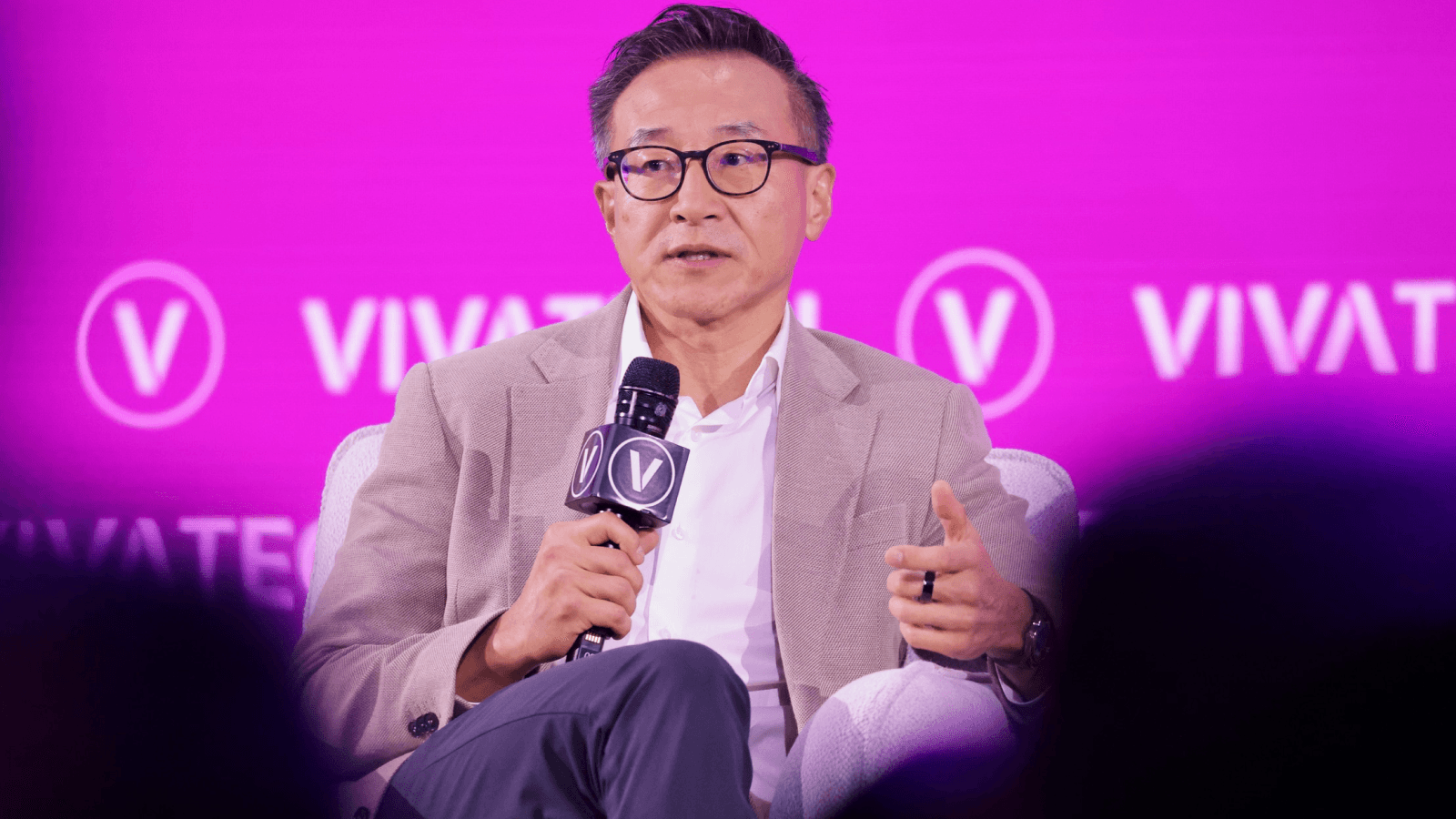
Artificial intelligence may have dominated the conversations at VivaTech 2026, but one question ran through many of them: how can businesses and governments avoid becoming dependent on a single AI ecosystem? This question was at the heart of the session Look East: China's AI Ascent and the Full Stack Advantage, where Alibaba Co-Founder and Chairman Joe Tsai joined Christophe Jakubyszyn, Editor in Chief of Les Echos.
VivaTech Co-Founder Maurice Lévy opened the session with a fact few in the audience expected.
The world's most widely used open-source AI model, he revealed, is not ChatGPT or Claude. It is Qwen, Alibaba's open-weight model.
That set the stage for a conversation with Joe Tsai about AI, open source, and technological sovereignty.
From marketplace to AI
Tsai reflected on Alibaba's evolution since its founding in 1999 as a business-to-business marketplace connecting Chinese manufacturers with overseas buyers.
Today, Alibaba serves 820 million consumers in China, while European brands sell €30 billion worth of products to Chinese consumers each year through its platforms.
That scale, he argued, has allowed the company to invest heavily in AI while continuing to fund its ambitions through a business that generates 5 billion in annual free cash flow.
For Tsai, AI is fundamentally about human productivity.
"Of more than 100 trillion dollars of global GDP, at least half of that, 50 trillion, is about human productivity and human intelligence. And that is the TAM of AI."
Viewed through that lens, he dismissed concerns that AI investment has become excessive, despite US hyperscalers planning to spend more than a trillion dollars on AI infrastructure next year.
Open source and sovereignty
The discussion then turned to one of VivaTech 2026's defining themes: sovereignty.
"If you ask 10 Europeans about what sovereignty means, you'll get 12 different answers," Tsai said, before identifying two priorities that frequently emerge: technology independence and data privacy.
He argued that open-source models offer organisations greater control. Qwen can be downloaded and fine-tuned using private data behind a company's own firewall, allowing businesses to deploy AI without relying entirely on an external provider.
Asked whether European organisations should worry about becoming dependent on Chinese AI providers in the same way they worry about dependence on American ones, Tsai did not dismiss the concern.
Could Beijing one day cut access? "Yeah, you can't be sure" he replied.
Rather than arguing China was a safer option, he suggested organisations should avoid relying on any single provider.
"Right now, all of your eggs are in one basket. Why not get a second basket to put your eggs in?"
As AI becomes part of critical business infrastructure, the discussion at VivaTech reflected a broader shift in thinking. The question is no longer simply which model performs best, but how organisations build AI strategies that are resilient, flexible, and avoid dependence on a single provider.


