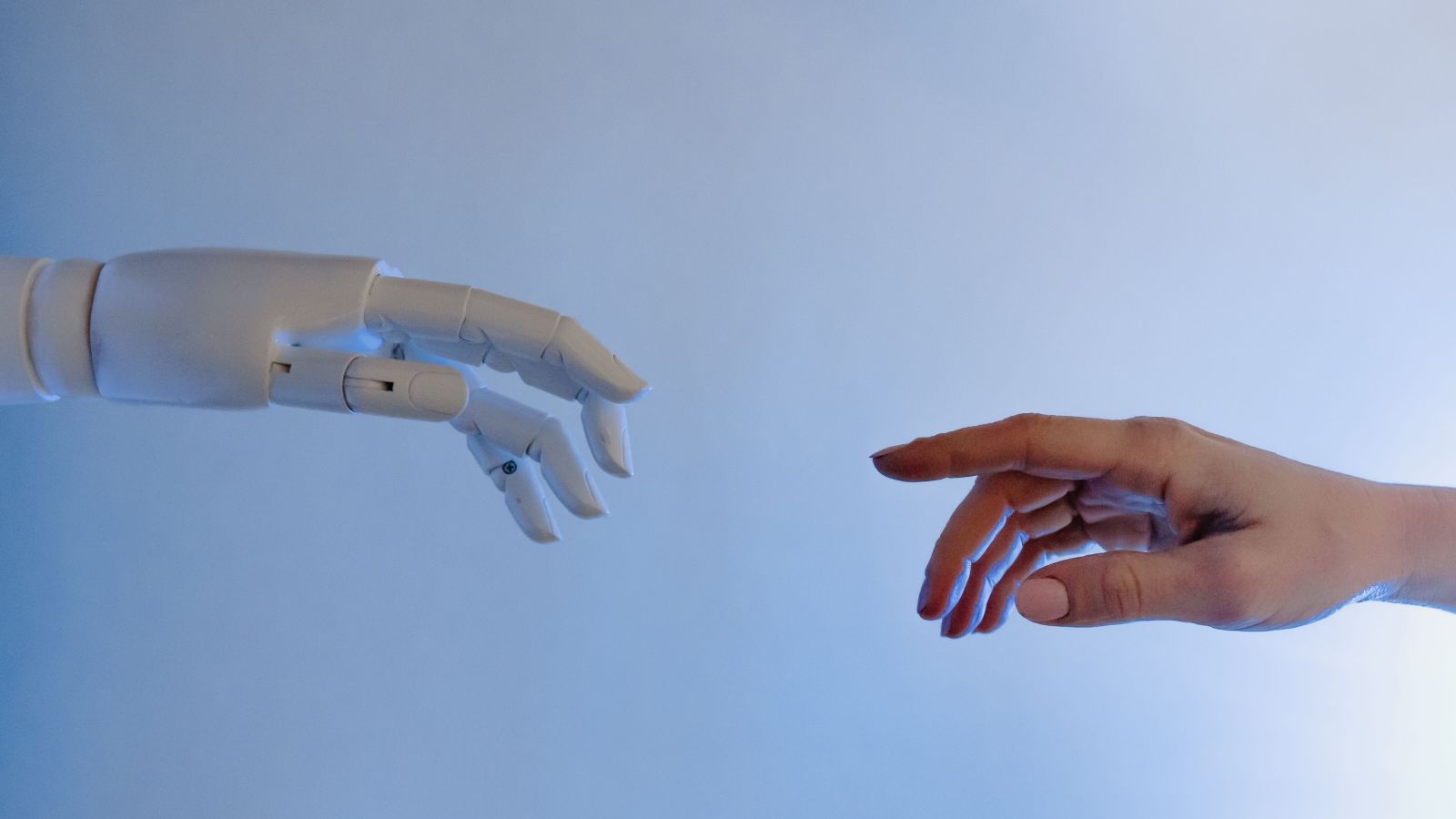
 Human-AI collaboration is when people and artificial intelligence work together to accomplish tasks better than either could alone.
It turns out that the biggest productivity gains don’t come from handing work over to machines, but from combining human judgment with machine intelligence.
From tool to teammate: how the relationship is changing
The first wave of enterprise AI focused on automation. Businesses identified which tasks machines could perform faster, cheaper, or at greater scale.
Now the shift is toward augmentation. Instead of replacing employees, AI is increasingly helping them do higher-value work.
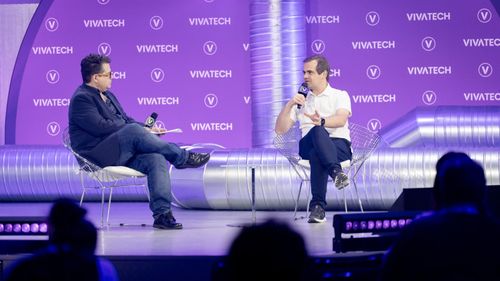
"Agentic AI allows us to automate vast parts of processes, and so it changes how we create value, how we organize work and how we develop skills,” explained Éric Salobir, President of the Human Technology Foundation, at VivaTech 2026. “Faced with this shift, the question is not only what AI can do in a company, the question is what do we want to do and to be together?"
Why "AI replacing humans" misses the point
Predictions that AI will eliminate entire professions often overlook how work actually gets done.
Most jobs are made up of dozens of different tasks. Some are repetitive and rules-based. Others require negotiation, ethical judgment, emotional intelligence or creativity.
AI excels at repetitive and rules-based tasks such as processing information, recognizing patterns, and generating content at speed. But humans are still far better at understanding nuance, navigating ambiguity, building trust and making decisions when the stakes are high.
Because of this difference, the future of work is unlikely to be humans versus machines, but defined by how effectively organizations distribute work between the two.
The augmentation shift—and what it means for how we work
Today's AI systems can draft reports, analyze contracts, write code, generate marketing copy and even act as conversational assistants. AI agents are beginning to complete multi-step workflows with increasing autonomy.
Still, these capabilities don't remove the need for human oversight—they actually increase it. "AI doesn't happen to people, it happens with people," Denis Machuel, CEO of the recruitment agency Adecco, told the VivaTech audience.
As AI becomes more capable, humans move further up the value chain. Instead of doing every step themselves, employees can instead review, guide, validate and improve AI-generated work.
Researchers at MIT looked at the risks of AI automation for over 800 different jobs and found that four out of five occupations are likely to evolve into a combination of automation and human innovation. This means collaboration—not replacement—is becoming the dominant model of work.
Where human-AI collaboration is already working
Human-AI collaboration is already happening across industries that understand AI's strengths and limits.
Healthcare: faster discovery, better decisions
Healthcare is one of the clearest examples of effective collaboration between humans and AI.
AI systems can analyze medical images, identify anomalies, summarize patient histories and accelerate drug discovery by processing enormous amounts of biological data. But final diagnoses, treatment decisions and conversations with patients still depend on doctors.
AI isn’t replacing medical professionals, but it is reducing administrative burden and surfacing information that allows doctors to make faster and more informed decisions.
Creativity: AI as a creative partner, not a replacement
Creative work has become a major testing ground for human-AI collaboration.
Designers use AI to generate concepts. Writers can create multiple drafts more quickly. Developers rely on AI coding assistants to accelerate routine programming tasks.
But AI is rarely original. Creative work still depends on human taste, cultural understanding, storytelling and strategic direction.
The workplace: rewriting what productivity means
Early conversations about AI in the workplace often revolved around efficiency: how many hours could be saved, how many tasks could be automated, or how much faster teams could work.
But in fact, the bigger opportunity is in redesigning work itself.
Take the example of software development. At VivaTech, Stéphane Bout, a senior partner at McKinsey specialized in agentic AI, described how AI coding assistants are collaborating with developers to supercharge their work: "The step change comes when you reinvent the whole delivery model from scratch, redistributing tasks between humans and agents,” said Bout. “In that case, you can reach 50-70% productivity gains."
Instead of spending hours searching for information, coding, drafting repetitive emails, creating presentations or compiling reports, employees can increasingly lean on AI to handle routine tasks. That frees people up to focus on high-value work such as solving problems, collaborating across teams and making better strategic decisions.
"There's much more collaboration between developers, because we spend so much less time actually writing the code,” said Stanislas Polu, a software engineer & co-founder of Dust, an enterprise platform for building and managing AI agents. “It displaces the work into deciding what to do, which requires more collaboration, more chatting, more working together."
AI is becoming what many organizations describe as a "copilot"—a partner for workers that improves productivity without removing human responsibility.
What humans bring that AI still cannot
For all of AI's capabilities, it doesn’t have lived experience, moral responsibility or genuine understanding.
Judgment, empathy, and the irreducibly human
Important business decisions require context, ethics, emotional intelligence and an understanding of human consequences.
AI can present options and summarize evidence. But its people who need to decide which path aligns with organizational values, customer expectations and societal norms.
The same applies to creativity. While AI can generate thousands of possible ideas, it can’t determine which idea resonates the most culturally, inspires people or builds lasting trust.
The more capable AI becomes, the more valuable distinctly human skills become.
Why trust between humans and AI has to be built, not assumed
Collaboration depends on trust, but trust can’t just be programmed into AI systems.
Employees need confidence that AI outputs are accurate, explainable and right for the task at hand. Organizations need governance that defines when AI can make recommendations and when human approval remains essential.
Transparency also matters. People are far more likely to use AI tools when they understand how their recommendations are generated, what data was used to train them and where uncertainty exists.
The skills and culture shift this requires
Organizations that gain lasting value from AI invest as much in people, processes and culture as they do in models and infrastructure.
What organizations need to do differently
Leading companies are maturing beyond AI pilots toward organization-wide transformation.
Leading companies are maturing beyond AI pilots toward organization-wide transformation. That means redesigning workflows instead of simply inserting AI into existing ones. "It's important to anticipate that there is not one unique way of working,” advises Bout. “Teams will have to adopt a different approach depending on the nature of the work they do."
It also means establishing governance frameworks, defining accountability and creating clear policies for responsible AI use.
Finally, getting it right requires encouraging experimentation. Employees need to feel empowered to test new AI tools, learn from failures and discover where AI genuinely improves their work.
The new literacy: working with AI, not around it
Tomorrow's workforce will need more than technical expertise—they'll need AI literacy.
"It's going to transform the job of everyone,” said Cécile Béliot, CEO of the Bel Group, at VivaTech 2026. “So how can we together bring the best way to upskill everyone, making sure we know how to build this hybrid workforce, working well together."
Employees need to understand what AI can and can’t do, how to write effective prompts, validate AI-generated information, recognize bias, protect sensitive data and when human judgment should override machine recommendations.
These will become foundational workplace skills across every industry. Closing the AI skills gap is critical for businesses who want to fully take advantage of human-AI collaboration.
The risks of getting collaboration wrong
Without thoughtful design, organizations risk creating new problems, even while solving old ones.
Over-reliance, deskilling, and the accountability gap
One of the biggest risks is workers becoming over-reliant on AI. If people start accepting outputs without enough scrutiny, it creates the opportunity for errors, hallucinations or biased recommendations to spread quickly through organizations.
There's also the risk of deskilling. If AI consistently performs analytical or creative tasks for employees, they could lose the ability to do it themselves. Over time, this can make organizations increasingly dependent on technology while reducing the expertise needed to supervise it.
Perhaps the most difficult question around AI is about accountability. When AI contributes to a decision, who is responsible for the outcome? The answer should be humans. AI can inform decisions, but accountability can’t be delegated to an algorithm.
Designing AI systems that keep humans in the loop
The strongest AI systems are designed around human oversight. This means building review points into workflows, making AI reasoning explainable where possible, and ensuring that critical decisions always include human approval.
Polu described what the workflow looks like when developers at Dust collaborate with AI agents: "We should very quickly not be coding anymore at all. We'll be supervising, we'll be looking at the code, we'll be coaching the model, but there's very few lines of code we'll be writing."
Keeping humans in the loop makes AI more reliable, more trustworthy and ultimately more valuable.
What genuine human-AI collaboration looks like next
Human-AI collaboration is still in its early stages. But as AI models become more powerful, we'll increasingly work alongside systems that can plan, reason across multiple steps, and complete complex tasks with minimal supervision.
The challenge for organizations will be learning how to integrate AI in ways that strengthen human decision-making instead of weakening it.
Agents, copilots, and the next generation of collaboration tools
The first wave of generative AI chatbots were able to answer questions or generate content on demand. The next wave is capable of carrying out entire workflows.
Agents can combine multiple tasks such as gathering information, analyzing data, drafting documents, coordinating with other software and proposing next steps.
With human-AI collaboration, professionals will increasingly supervise teams of specialized AI systems. For example:
- A marketing manager might oversee agents that conduct audience research, generate campaign concepts and analyze performance metrics.
- A software engineer could coordinate coding agents that write, test and document new features.
- A doctor may rely on multiple AI tools that support diagnosis, summarize patient histories and monitor treatment outcomes.
Still, as AI becomes more autonomous, the role of human judgement becomes more crucial, argues Polu: "When the AI is doing most of the work, the importance is really knowing what to build. It's not anymore knowing how to build, it's knowing what to build.”
Building a future of work that works for everyone
The World Economic Forum's Future of Jobs Report 2025 estimates that by 2030, technology could create 170 million jobs, displace 92 million others and transform or render obsolete 39% of existing skill sets.
That points toward a future where AI changes almost every profession, but human contribution is still highly relevant. And Polu predicts that many future jobs will look very different from today’s: "In five years, it's 100% sure we'll be looking at people working and we'll be like, 'That's not work.'"
Successfully navigating this transition will depend on organizations investing in three areas at the same time:
- Technology that augments people rather than replacing them.
- Skills that enable employees to work confidently with AI.
- Governance that ensures AI systems remain transparent, accountable and aligned with human values.
Organizations that balance all three will be better positioned to innovate while maintaining trust among employees, customers and society.
"This goal that we all have [is] to make sure the hybridization of the workforce is respecting the human side of the labor market,” says Machuel. “And that's fundamental if we want a humanity that is at peace."
For more on the future of human-AI collaboration, watch this session from VivaTech 2026: “Your Next Coworker Is Here and He Isn’t Human”