Key numbers
- 200,000 attendees
- 165 countries
- 4,500 partners
- 30+ business sectors represented
- +15,000 startups
- 5 Billion+ Reach Social Media
- 8.2 million reach VivaTech NEWS
- 8,000 sqm of exhibition space on the Champs-Élysées
Key Takeaways
- Sovereignty became Europe's defining technology priority. Across AI, cloud, cybersecurity, semiconductors, quantum computing, and defense, the debate centered on how Europe can build and control the technologies it depends on.
- AI entered the deployment era. The focus shifted from chatbots to autonomous agents already transforming software development, enterprise workflows, and customer operations.
- Space became a strategic business. From Jeff Bezos and Blue Origin to Europe's emerging launch companies, commercial spaceflight moved from aspiration to industrial reality.
- Infrastructure emerged as the next AI battleground. Energy, data centers, compute capacity, and digital infrastructure became as important to AI discussions as the models themselves.
- Innovation moved beyond the exhibition halls. VivaTech expanded into the city with its Champs-Élysées activation, launched its first Festival Day, welcomed India's Prime Minister Narendra Modi, and introduced the inaugural VivaTech x Bloomberg Awards.

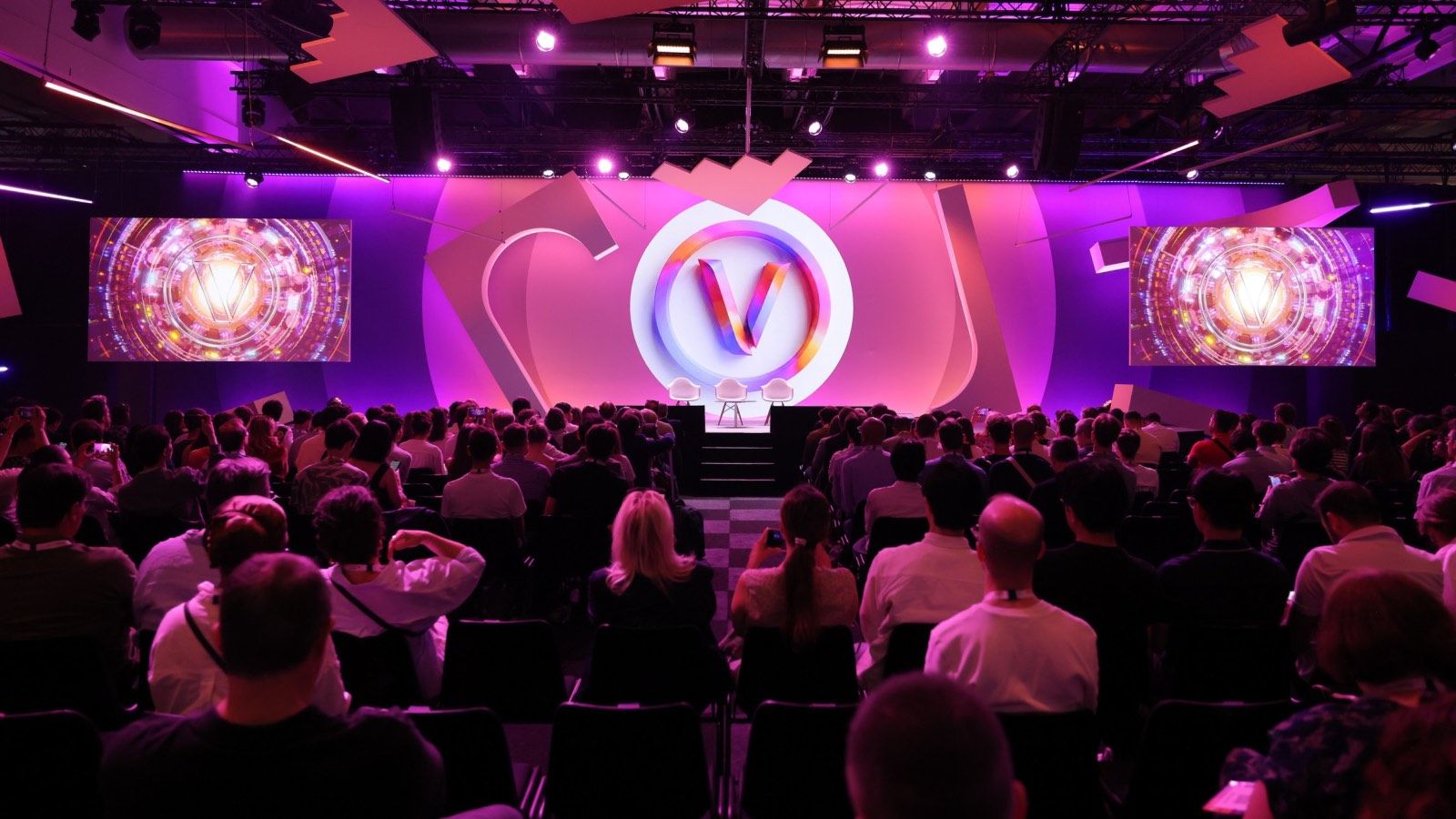
This year, VivaTech celebrated its tenth edition, welcoming a record 200,000 visitors from 165 countries, alongside more than 15,000 startups and 4,500 partners. Yet the numbers tell only part of the story. The real shift was in the conversation. AI moved from possibility to deployment, space emerged as one of the week's defining themes, and nearly every discussion about the future of technology converged on the same questions: competitiveness, sovereignty, and how Europe can build the next generation of global technology leaders.
Europe's Sovereignty Moment

If one word defined VivaTech 2026, it was sovereignty. The event featured 175 sessions with "sovereignty" in the title, underlining just how central the topic has become to Europe's technology agenda.
Whether the focus was artificial intelligence, cybersecurity, cloud infrastructure, semiconductors, quantum computing, or defense, speakers repeatedly returned to the same question: how can Europe build the technologies it depends on rather than relying on others?
That ambition was reflected across the exhibition floor. Germany was named VivaTech's 2026 Country of the Year, making it the first European nation to receive the distinction highlighting a renewed commitment to cross-border innovation.
For many speakers, the turning point had a name. Christel Heydemann, CEO of Orange, described the suspension of Anthropic's Mythos model for non-US users as "the Mythos wake-up call," a moment that shifted the focus from model performance to control over the infrastructure behind AI.
That perspective wasn't limited to European voices. Alibaba Co-Founder and Chairman Joe Tsai argued that technological sovereignty is less about choosing sides than avoiding dependence altogether. Discussing open-source AI, he suggested organizations should reduce their reliance on a single provider: "Right now, all of your eggs are in one basket. Why not get a second basket to put your eggs in?" His point echoed a broader theme across the event: resilience comes from having options.
Discussing AI infrastructure, Brian Burns, AI Infrastructure Leader at Strategy&PwC, pointed to the scale of the opportunity ahead. "We're expecting 2 trillion of capital to be deployed in the AI space between now and 2050. That's the largest mobilization of capital in the history of humankind."
But investment alone is not enough. For Olivier Biton, Head of Technological Transformation at Crédit Agricole, sovereignty ultimately comes down to control. "You need to know where your data are, who can access them, and who can shut your services in what time frame," he said, warning that Europe cannot afford to delay building its own AI infrastructure.
The discussion also extended to digital security. Ledger CEO Pascal Gauthier argued that in an age of AI-powered cyberattacks, technological independence is becoming fundamental to democracy itself. "If you're a citizen, you're not secure, and you cannot have a private life, you're not free. So it's the roots of democracy that are challenged."
The message was consistent: Europe has the talent to compete. The challenge now is turning its researchers, engineers, and startups into global competitors and building the infrastructure they need to succeed.
AI Moves From Assistants to Agents
AI Enters the Real World
Artificial intelligence dominated VivaTech 2026, but unlike previous editions, the focus was no longer on what AI might become. It was on how organizations are already putting it to work.
For many speakers, that shift is already underway. Reflecting on software development, Dust Co-Founder Stanislas Polu explained that "we code maybe 20% of the time and the rest is written by the machine," adding that "Anthropic's Opus 4.5 in November" represented "a real step change." Peter Steinberger, Founder of OpenClaw, described the next evolution: "We went a level up to talk to AI, and now we went up another level where AI talks to AI." Looking ahead, he predicted "a billion programmers that don't know that they program because all they do is they ask their agent for a solution to something."
As AI moves into production, a new bottleneck is emerging: energy. Data centers already consume around 1.5% of the world's power, a share expected to double by 2030, while connecting new capacity to Europe's grid can take seven to ten years.
Speakers argued that energy is becoming AI's limiting factor. Pablo Koziner, Chief Commercial and Operations Officer of GE Vernova, described a "supercycle" of electricity demand that could rise from roughly 20% today to nearly 50% by 2050. Philippe Piron, CEO of GE Vernova's Electrification business, warned that "AI factories" can swing by up to 15 megawatts in milliseconds, fluctuations traditional grids were never designed to handle. His conclusion captured the shift: the cost of an AI token is increasingly tied to the cost of energy, making electricity the next competitive advantage.
Space Takes Center Stage

If AI was the dominant theme of VivaTech 2026, space was undoubtedly its most ambitious.
During the Opening Ceremony, attendees received a special video message from astronauts aboard the International Space Station. It was a fitting opening for an edition where space emerged as one of the event's defining themes.
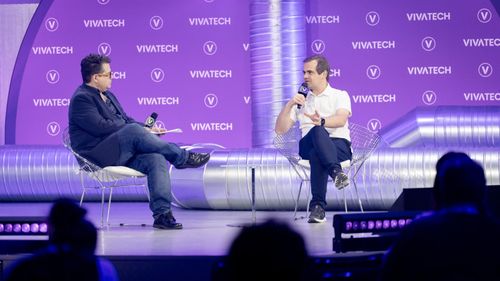
The momentum continued on Day One as Jeff Bezos joined Blue Origin CEO David Limp on the VivaTech stage to discuss the future of commercial spaceflight. For Bezos, the industry's biggest challenge is no longer demand, but capacity. As he put it, "Every space company you can think of has a backlog. The demand for launch is insatiable. We are not demand constrained. We are supply constrained."
European companies were among the standout voices. Hélène Huby, founder and CEO of The Exploration Company, argued that Europe has the talent and ambition to compete globally, while Yohann Leroy, CEO of Maia Space, highlighted the challenge that remains. "We have in Europe the expertise, we have the technology, the skills that allow Europe to solve the famous rocket equation. What Europe misses is the ability to solve this rocket equation at conditions that are viable from an economic standpoint." The message was echoed across multiple sessions: Europe's next challenge is no longer proving its engineering excellence, but turning that excellence into commercially competitive space businesses.
The event closed with European Space Agency astronaut Thomas Pesquet, whose appearance filled the VivaTech Theater to capacity, bringing the space narrative full circle after it had begun with the International Space Station. Reflecting on nearly 400 days in orbit and the perspective it offers, he remarked that "it is true that it is hard to do justice to the beauty of the Earth," reminding the audience that while commercial spaceflight is accelerating rapidly, exploration continues to change not only where we can go, but how we see our own planet.
From reusable capsules and lunar ambitions to commercial launch services and sustainable life-support systems, VivaTech 2026 showed that space is no longer a distant frontier. It has become one of the world's fastest-growing strategic industries.
Key Moments
Prime Minister Narendra Modi takes the VivaTech stage
One of the week's biggest crowds gathered to hear Indian Prime Minister Narendra Modi, with India returning as VivaTech's first AI Country Partner. His message was simple: AI only matters if it reaches everyone. From the country's digital payments infrastructure to AI tools for dairy farmers, drone pilots, and fishermen, he argued that innovation should be "all inclusive."
A new tech awards ceremony is born
VivaTech and Bloomberg launched the inaugural VivaTech x Bloomberg Awards, recognizing the people and organizations shaping the future of technology. Sir Tim Berners-Lee received the Visionary Award, Joe Tsai the Leadership Award, Yann LeCun the Momentum Award, Peter Steinberger the Breakthrough Award, Jeannette zu Fürstenberg the Investor Award, May Habib the Rising Star Award, and Ukraine the CitizenTech Award.
VivaTech heads to the Champs-Élysées
Before the doors even opened, VivaTech spilled out into Paris. To celebrate its tenth anniversary, more than 35 demonstrations transformed the Champs-Élysées into a free, open-air showcase of AI, robotics, health, mobility, and space technologies.
A Festival for the next generation
Saturday looked different. Students, families, creators, and aspiring entrepreneurs took over the halls for VivaTech's first Festival Day, with coding workshops, robot demonstrations, startup competitions, mentoring sessions, and hands-on AI experiences.
That's a wrap on VivaTech 2026
What started as a bold bet has become a global meeting place for innovation. Here's to the next decade of innovation! See you in Paris for VivaTech 2027.