The AI boom is powered by more than innovation – it’s powered by electricity. AI energy consumption has started to attract serious scrutiny, especially around the data centers where large-scale AI models are based and trained.
This debate about AI growth and sustainability raises a key question: Can data centers be sustainable even as AI energy consumption soars? In this article, we look at AI’s environmental impact and the ways data centers can adapt to power a sustainable energy future.
Why Does AI Use So Much Energy?
AI’s energy needs come from how its models are built and deployed. Training advanced models like large language models (LLMs) requires massive computing resources, such as thousands of graphics processing units (GPUs) running constantly for days or weeks.
This AI workload requires high power density, high heat output, and near-constant peak performance – all of which ramp up energy consumption. According to an April 2025 report by the International Energy Agency (IEA), the electricity consumption of all global data centers combined is projected to double by 2030 to around 945 terawatt-hours (TWh), and AI is the biggest driver of this growth.
Recognizing this energy cost, many companies are focused on how to balance AI energy consumption with the technology’s potential to provide greater overall efficiency and sustainability.
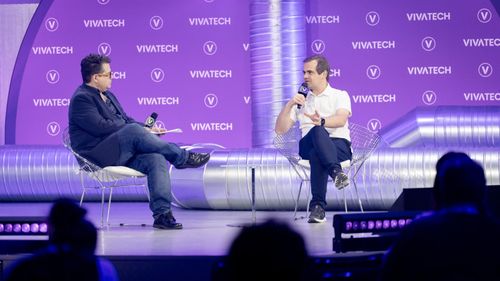
“There is a super strong increase in demand – between five times and ten times the energy needed for AI between now and 2030 or 2035,” Philippe Rambach, Chief Artificial Intelligence Officer of Schneider Electric, said on the VivaTech stage. “One of the key questions we need to address is, ‘What do we do with this AI?’ If we use the 600 terawatt-hours [consumed by AI data centers] to optimize the other 20,000 terawatt-hours, then it’s a good game.”
AI’s energy demands don’t end with training. Once an AI model is deployed, it may power millions of user queries every day, with each consuming electricity. The environmental footprint of data centers also includes water for cooling and greenhouse gas emissions.
While AI data centers haven’t reached the emissions levels of sectors like transportation, they are among the fastest-growing sources of electricity demand, and are straining power grids and water resources in many parts of the globe.
Solutions and Opportunities for AI Data Centers
“Yes we need a lot of energy for AI, but AI can also help save a lot of energy,” says Rambach.
AI technologies that reduce energy demand or shift it toward clean sources can make a meaningful impact when it comes to broader sustainability goals.
More Efficient Hardware Design
One major opportunity for reducing AI energy consumption is in the hardware itself. Traditional CPUs and even many GPUs were not originally designed for AI workloads, so they can be inefficient when executing massive calculations.
“The main thing that’s driving that energy consumption is compute chips,” says Ami Badani, Chief Marketing Officer at Arm Holdings, an advanced AI semiconductor and software design company. “50% of energy consumption of any of these language models is the compute chip itself.”
Emerging hardware architectures such as tensor processing units (TPUs), specialized AI accelerators and optimized next-generation chips could significantly improve performance per watt.
“In most data centers, we’ve been able to decrease energy by 40% by using Arm,” Badani told the audience at VivaTech. “The way we do that is by the layout of the chip itself. We’re able to lay out the chip in a way that you’re able to get maximum performance per watt with that design.”
Smarter Software and Workload Management
Efficiency isn’t just a hardware problem. Software optimization can also make a real difference in reducing AI energy consumption. Techniques like model pruning (removing unnecessary parameters), quantization (reducing precision where possible) and adaptive scheduling (running energy-intensive workloads when renewable energy is abundant) all reduce computational waste.
AI itself is also increasingly being used to optimize data center operations by adjusting resource use in real time to minimize waste. “If you want to use less energy to heat or cool a building, you need to have a model to simulate what happens in your factory or building,” explains Rambach. “Using machine learning you can build these models and use them to optimize. A basic room controller with a simple AI in it, and you save 20% of energy.”
Advanced Cooling Systems and Heat Reuse
Cooling is a major part of data center energy consumption, accounting for up to 40% of total power use.
Traditional air-based cooling systems struggle to keep up with the heat generated by AI data centers. Switching to liquid cooling systems, which run coolant through AI systems to dissipate heat, can cut energy demand significantly. But these systems require a lot of water.
To help offset that demand, data centers could use an ancient technique: rainwater collection. In fact, Google and Microsoft have already implemented rainwater collection systems at AI data centers.
Another approach is to reuse heat generated by AI data centers for other purposes, such as heating commercial or residential spaces. Waste-to-energy systems can turn what was once contributing to a data center’s environmental footprint into a resource.
Renewables and Location Optimization
The IEA reports that renewables are the fastest-growing source of electricity for data centres, increasing at an average rate of 22% per year and expected to cover nearly half of additional demand by 2030. Transitioning to renewable energy sources through power purchase agreements (PPAs), solar and wind installations, and partnerships with green energy providers can improve the sustainability of AI data centers.
Where an AI data center is located can also reduce its overall impact. Facilities with access to clean energy and in cooler climates can cut both cooling and grid emissions.
Data centers located in areas with geothermal resources can also take advantage of direct data center cooling to reduce energy and water demand. According to the research group Rhodium, enhanced geothermal systems could meet AI demand growth at prices 31-45% lower than in current clustered AI center locations in the U.S. such as Northern Virginia, Atlanta and Phoenix.
The Future Role of AI in Energy Sustainability
AI tools are already being used to improve energy efficiency in ways that could accelerate decarbonization. At the COP30 climate summit and on the VivaTech stage, stakeholders have highlighted how AI can further support climate solutions if built and deployed responsibly.
“AI is a tool that can be used to reduce the cost of adoption, reduce the cost of deployment, of many of the techniques that will help with energy transition, and help fight climate change,” argues Rambach. “So I see AI helping reduce, helping remove the peak and helping build data centers more efficiently.”
Instead of framing AI and sustainability as opposing forces, the challenge is to align AI innovation with green infrastructure, smarter operations and cleaner energy transitions.
“Fast forward five years and the progress we’re making with AI, I truly believe will help drive innovations in terms of energy consumption and preserving energy,” says Badani. “If we use AI for the right ways, I think the future will actually be better than the present. And that will obviously require a lot more energy.”
AI and GreenTech are key themes at the next edition of VivaTech. Join us there to see the world’s leading AI with your own eyes!