If you only have 2 minutes
Bezos unveiled Prometheus, an AI venture built to do physical engineering that standard language models cannot handle
McKinsey told Stage One that 80% of large companies now invest in AI but only 6% see any profit impact, barely up from 4% a year earlier. Their verdict, it is an execution problem, and "AI is no longer a tool, it's a workforce.
Commissioner Ekaterina Zaharieva and Mistral co-founder Jean-Charles Samuelian made the positive case for Europe, 30% more AI engineers than the US, and her line landed hard, "we are not rich enough to buy cheap products.”
The Center for Humane Technology's Daniel Barcay warned that technology has stopped competing for our attention and started competing for our affections.
DeSantis confirmed the US government asked Anthropic to pull its Fable model after Amazon flagged a security vulnerability.
A WEF and ManpowerGroup panel named the reskilling gap, 70% of companies spend on AI but only 20% invest in helping their people learn it.
With La Poste's hybrid model, every item now passes through at least one AI on its journey.
The Day in Data
41 minutes. How long Blue Origin's BE-7 lunar engine ran in a single continuous test, breaking a Space Shuttle record that had stood for 30 years. (David Limp, Blue Origin) from Building the Road to Space
26 billion euros, BNP Paribas loans to aerospace and defense.(Yannick Jung, BNP Paribas) from Built to Last: The Business of Long Term Success
35%. The share of times that clicking "do not consent" on a tracking banner has no effect, because nothing forces compliance. A preview of how the AI data economy may behave at scale. (*John Bruce, Inrupt) from Your AI Is Building a File on You 3rd number
2.6 billion. People who still have no connectivity, even though 95% of them live under mobile broadband coverage. (Hans Vestberg, Verizon) Session: The New Rules of Scale and Resilience
They Say It Best
- “AI today is a way to disseminate knowledge, It is just another step in making people smarter, the way the printing press was. So if you are going to block it because you think it is dangerous, you are being a medieval obscurantist.” - Yann Le Cun, Founder, Advanced Machine Intelligence Labs
- "The question is no longer who has the best model. The question becomes who remains in control." - Christel Heydemann, CEO, Orange
- "Energy is the foundation of the AI economy. It is not one stage among five. It is the foundation." - Tajeddine Seif, K&K Group
- "255 billion dollars went into AI in the first quarter of 2026 alone, more than the whole of 2025. Within one quarter we set a new record. Absolutely ridiculous numbers." - Nalin Patel, Director of Research, PitchBook
Session Spotlight
Building the Road to Space
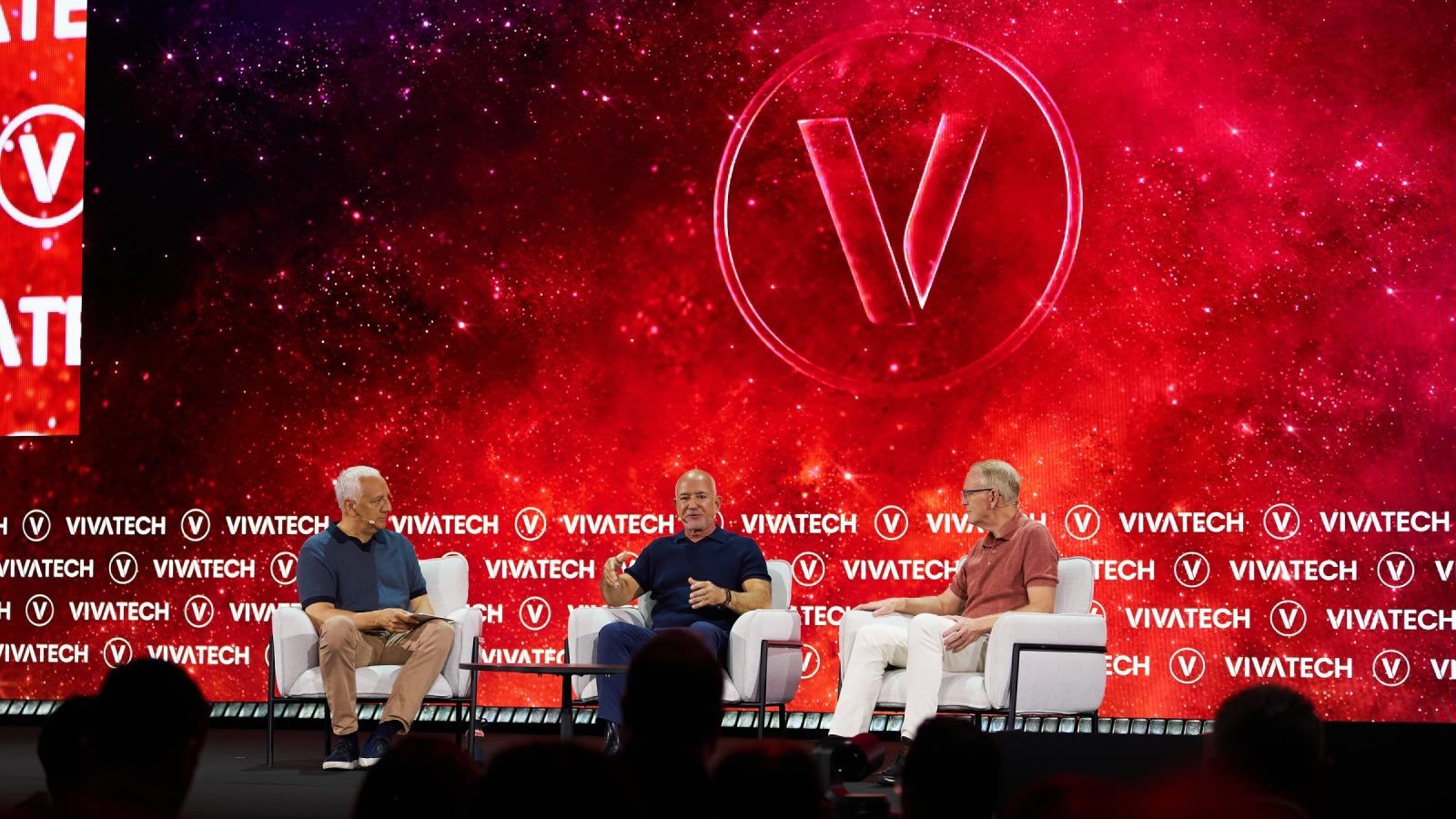
"We go to space not necessarily just for space, but for Earth." Jeff Bezos, Founder of Amazon and Blue Origin and Founder & Co-CEO of Prometheus
Jeff Bezos opened up on Blue Origin's recent New Glenn launchpad anomaly, which he called a gut punch the team answered within 24 hours by restarting reconstruction around the clock. His core argument was that the space economy is real and supply constrained, not demand constrained, because every launch company is sitting on a full backlog. He named the moon, not Mars, as the priority, calling it "a gift" for its proximity, its confirmed water ice, and the 28 times less energy needed to lift materials off its surface. Bezos laid out a dense roadmap toward a permanent presence, with the Mark I lander in early 2027 and the goal stated plainly, "We are going to the moon to stay." He closed on Prometheus, an AI built for physical engineering rather than text, and on his belief that AI will create a labor shortage by letting people tackle far more problems than they can today.
If you liked this session, don't miss: Quantum Leap: When Will Quantum Computing Deliver Business Value? Purple Stage, June 18, 09:45, with IBM, Pasqal, Fraunhofer and McKinsey
Beyond Language Models: Building AI that Understands the World

"I tell people in AI, you should stop doing generative AI. And of course, that does not make me very popular." Yann Le Cun, Founder, Advanced Machine Intelligence Labs
In the VivaTech Theater, Yann Le Cun, Turing Award laureate and longtime head of fundamental AI research at Meta, made his first major appearance since leaving the company to start Advanced Machine Intelligence Labs. He was careful to praise large language models as useful and superhuman in narrow areas like translation and code, then drew a hard line: "There is simply not a path to human-level intelligence" by scaling them up. His company is built on world models and an approach called JEPA (Joint Embedding Predictive Architecture), which learns abstract representations of reality instead of predicting video pixel by pixel. Le Cun spent his sharpest minutes defending open source, comparing efforts to restrict it to the Catholic Church resisting the printing press and naming Anthropic as a company lobbying to make open source effectively illegal. He closed on Project Tapestry, a federated effort to let any country or university help train a shared open model without handing over its data.
If you liked this session, don't miss: Open vs Closed: Who Gets to Build AI? Stage One, June 18, 12:25, with Thomas Wolf of Hugging Face, JetBrains, and Nebius
Europe’s Tech Moment: Building Competitiveness, Security & Sovereignty

"For years, Europe was known mainly for regulating technology. But today, Europe is equally determined to build it." Henna Virkkunen, Executive Vice President for Tech Sovereignty, Security and Democracy, European Commission
Henna Virkkunen, the European Commission's Executive Vice President for Tech Sovereignty, used her twenty minutes to answer a critique that has followed Europe for years, that it only knows how to regulate. She grounded her case in numbers from that morning, with 79% of EU citizens ranking digital policy a top priority and 85% backing investment in European infrastructure. The European Tech Sovereignty Package she detailed rests on three pillars, CHIPS Act 2.0 across the full semiconductor chain, a Cloud and AI Development Act that aims to triple data center capacity by 2030 to 2035, and open source as a strategic asset. She was candid about the financing gap, noting that Europe attracts about 5% of global venture capital while its households sit on more than 33 trillion euros in savings. She closed by naming the missing pieces, compute, chips, capital, and confidence, with 19 AI factories already live and a first call for European AI gigafactories coming very soon. Her closing line to the founders in the room was direct, "Europe should not only use the technologies of the future. Europe should create them."
If you liked this session, don't miss: Sovereign by Design, VivaTech Theater, June 18, 10:00, with Gundbert Scherf of Helsing and Jeannette zu Fürstenberg of General Catalyst
Stage Panorama
Stage One
Stage One ran the day's most strategic program, and a single thread tied it together, control. The week's suspension of a US AI model for non US users turned the dominant question from who has the best model into who stays sovereign over the infrastructure beneath it. The morning opened on the new architecture of money, with Circle and BlackRock describing a collision between AI and blockchain and an agentic economy where software transacts on its own rails. The afternoon hardened into a sovereignty debate that ran through finance, cloud, chips, and talent, from Accel and BNP Paribas reframing private markets as the new public markets, to Schwarz Digits and Orange arguing that performance is not a strategy when dependency is the real risk. Across every session the consensus held, the bottleneck is no longer the technology, it is execution, governance, and human adoption.
Red Stage
The Red Stage ran the most human program of the opening day. It moved from companion robots in care homes, to organs printed in a Vancouver lab, to surgery delivered across borders, to the biology of aging, and it closed on the question of who answers when an AI system decides. The connective thread was measurement. Speaker after speaker asked the same thing, what does this technology actually change in a human outcome, and who gets left out when it scales. The morning belonged to health, with hard deployment numbers from Intuition Robotics (ElliQ users average 55 interactions a day, ten times ChatGPT) and a clinical bioprinting roadmap from Aspect Biosystems backed by Novo Nordisk. The afternoon widened to capital and accountability, from a MENA energy and investment corridor to a closing panel that reframed governance as a brake pedal that lets you accelerate.
Purple Stage
The Purple Stage ran the business end of the opening day, the money and the megawatts. The morning belonged to startups, scaleups and growth, and the dominant fact was the sheer scale of AI capital. PitchBook opened with 255 billion dollars invested in AI in the first quarter of 2026 alone, more than all of 2025, with 80% of every venture dollar now going to AI, while Startup Genome showed AI-native value up 507%, roughly 12 times the rest of tech. The investors split on what to do about it, caution versus sovereign ambition, and a European thread ran underneath, from a 500 million pound UK sovereign fund to Zalando's case for a European dream built on a culture of courage. The afternoon delivered the physical reckoning. Data center capital expenditure now exceeds global oil and gas investment, grids are years behind, and the energy panels converged on AI as both the problem and part of the fix, with China hitting a 1,400 gigawatt renewable target five years early.
See You Tomorrow!
There’s still so much to come on stage at VivaTech over the next three days, so don’t miss a moment! Follow the latest announcements and highlights on Instagram, TikTok, and LinkedIn.
And if you’re sharing your own experience, tag @VivaTech and use #VivaTech so we can follow along with your journey at Europe’s biggest startup and tech event.