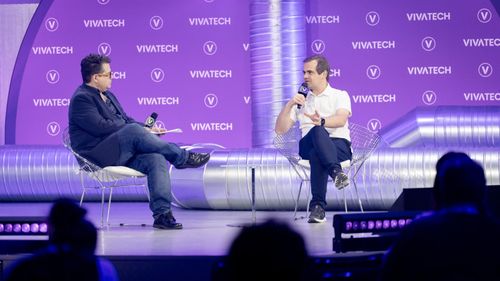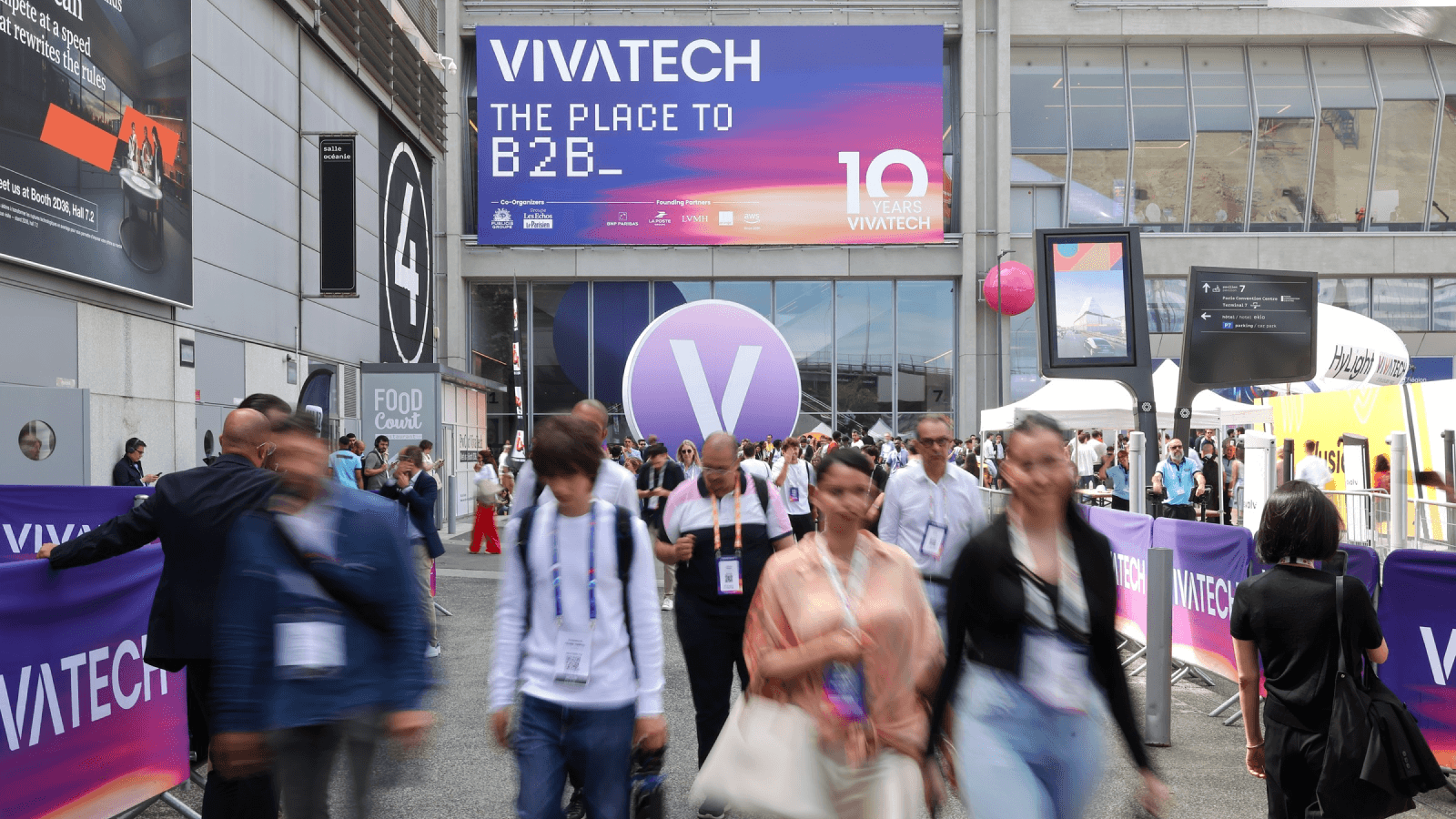
If You Only Have 2 Minutes
- Asmita Dubey, Chief Digital and Marketing Officer of L'Oréal Groupe, said "LLMs are becoming the front door to beauty discovery," while drawing a hard ethical line, "we will not use AI generated lifelike face, hair, body or skin."
- Theano Liakopoulou, Senior Partner at McKinsey, framed the enterprise race, "The winners are not the ones who have most of AI. They're the ones who have the best operating systems."
- Tal Goldstein, Head of Strategy at the World Economic Forum Centre for Cybersecurity, said cybercriminal revenues are "probably higher than the whole cybersecurity industry," with groups like Conti run "like a high-tech company."
- Roland Lescure and Anne Le Hénanff, French ministers, turned the tech gender gap into an economic argument, with Lescure calling it "just a massive mistake" to miss 50% of the talent pool.
The Day in Data
- SpaceX listing on NASDAQ, .5 trillion valuation, $86 billion raised.
- 7 out of 10 executives not trained on AI.
- 67% of Google queries answered on Google.
- 74% of European listed companies rely on US email services.
- 7,000 satellites placed in orbit in one recent year versus about 2,000 from 1958 to 2020.
They Say It Best
"There is a big temptation to put state first, strong, protects everybody, citizen second, in a system they cannot escape. This is very dangerous. This is Anakin Skywalker just before it becomes Darth Vader." - Pascal Gauthier, CEO, Ledger
"Gamers around the world recognize each other as gamers. They don't recognize nationalities. What a waste of energy that is." - Henk Rogers, Chairman of the Board, The Tetris Company.
"The store must be an omni-channel asset, the store must be a data asset, and the store must be a media asset, because that's where the traffic is, that's where the sales are." - Thierry Gadou, Chief Executive Officer, Vusion
“I think in real life gatherings have never been more popular never been a bigger interest to the culture and so how can software again support more of this stuff and and for all of us to spend less of our time absorbed in those screens” - Alexis Ohanian, Founder, Seven Seven Six & Reddit
“If market research works, then 100 % of products would be on shelf; And so what we did instead is we said rather than ever training on top of what people say they do or who they say they are, we train on top of real behavioral outcomes directly.” - Cameron Fink, Co-founder and CEO, Aaru
"A lot of times they need to not know the world's knowledge. They need to know your knowledge of your world." - Tony Fadell, Principal, Build Collective
"Our conviction is around innovation for all. It is about health as a right, not as a privilege, that innovation really should be for all people." - Hon Pak, SVP, Head of Digital Health Team, Samsung Electronics
Session Spotlight:
The Next Frontier: Humanity's Future in Space
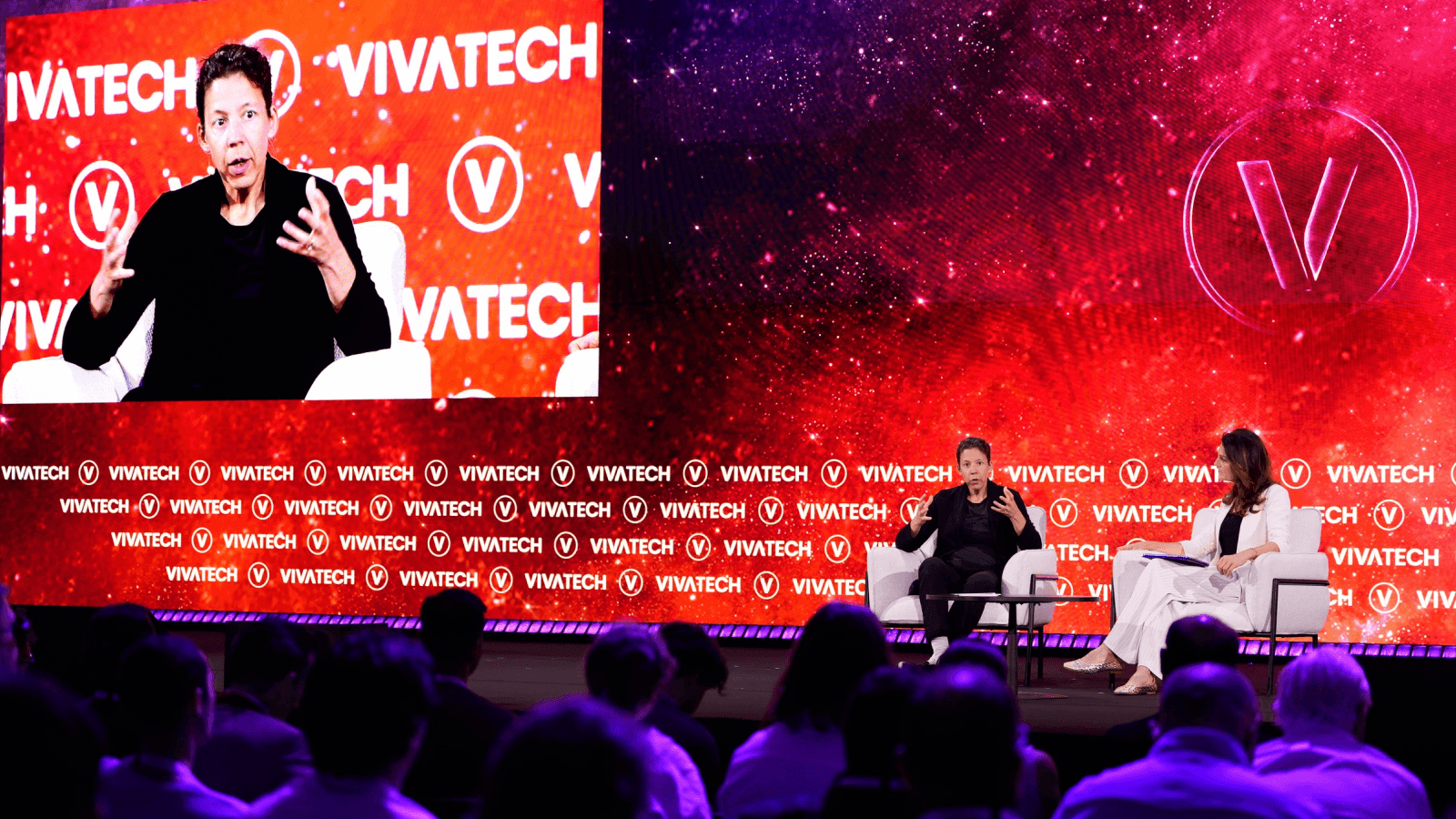
"It's not acceptable to just serve European sovereignty. Of course it's important, but we will serve better European sovereignty if we are number one worldwide." - Hélène Huby, Founder and CEO, The Exploration Company.
Hélène Huby opened her VivaTech Theater appearance with a simple argument: Europe has the talent and the capital to lead in space. What it has too often lacked is the confidence to try.
The founder of The Exploration Company explained why her company started with a capsule rather than a rocket. Europe had no independent crew or cargo capsule capability and was spending roughly €500 million a year to fly astronauts on American vehicles. In under five years, the company has flown two prototypes, secured €2 billion in contracts, and plans to launch a recurring cargo service to the space station in 2028.
Only then did it turn to launch vehicles, unveiling what she called the largest rocket engine model ever built in Europe, designed for a reusable launcher capable of carrying roughly twice the payload of Ariane.
The conversation quickly turned to sovereignty, as space technology is also military technology, Huby noted, and cross-border cooperation in advanced industries has helped underpin peace within Europe for decades.
She dismissed the idea that American dominance is inevitable, arguing that Europe's challenge is not talent or cost but creating the right conditions for growth. As evidence, she pointed to a €25 million ESA contract that helped unlock €250 million in private investment.
Huby closed with a call for Europe to commit to human spaceflight capability while a rare window remains open. With technical maturity increasing, NASA seeking additional crew capacity, and private capital flowing into the sector, she argued that the opportunity may not come again for generations.
Her final image was clear: a European capsule lifting off from French Guiana with European astronauts aboard, built by Europe and for Europe.
Keeping Humans in Control: Trust, Security & Ownership in the AI Era

"If you're a citizen, you're not secure, and you cannot have a private life, you're not free. So it's the roots of democracy that are challenged." - Pascal Gauthier, CEO, Ledger
In conversation with CNN's Melissa Bell, Ledger CEO Pascal Gauthier argued that AI has shifted the advantage to attackers: the cost of cyberattacks has collapsed, speed is instantaneous, and a single hacker can deploy thousands of AI agents at once.
His core argument was that digital ownership is now essential. While Bitcoin created the first form of digital private property, the bigger challenge is proving you are human in a world where AI can convincingly impersonate anyone.
As software becomes increasingly vulnerable, Gauthier argued that security must move back to hardware, comparing secure chips to Fort Knox: their strength comes from doing one thing and doing it well.
He extended the argument to sovereignty, calling cryptography, AI, and quantum computing a single strategic stack that Europe must master. With quantum-powered attacks approaching, he praised France's early investment in quantum-resistant security.
Gauthier closed with a broader political message: Europe should build the technologies it depends on rather than rely on others. "Business is war," he said. "The war is on."
Competing for Attention: The New Rules of Media Investment

"Human-made journalism is going to become more important and more rare in a world where provenance is difficult to understand." - Joy Robins, Global Chief Advertising Officer, The New York Times
At the CMO Summit, Jim Louderback, editor and CEO of Inside the Creator Economy, pressed three leaders on what brands really buy now. Joy Robins of The New York Times, Elsa Darquier of Brut, and Rob Bradley of CNN gave the same one-word answer: trust.
Brut put the sharpest figure on the table. Darquier said the company measures 85% trust among its audience against a French media average near 25%, a gap she credited to a format that shows the street rather than the journalist and lets viewers form their own opinion. Robins called trust hard earned and the reason subscribers pay The New York Times with time and money. Bradley extended it into influence, arguing news shapes how people vote and how they see brands.
The commercial core was ownership. Bradley said that being on a social platform makes you someone else's business model, so CNN keeps investing in owned assets where it controls the audience relationship. Robins defended direct subscriber relationships built on consistent values, warning that relinquishing brand equity to an LLM or an algorithm puts a media company at risk.
Each of the three companies is now building AI rather than renting it. CNN's in-house sentiment model, started six or seven years ago, unlocks roughly 90% more advertising inventory than off-the-shelf brand safety tools.
The New York Times launched a GenAI targeting tool called Brand Match about 18 months ago. Brut runs a team monitoring TikTok, Meta, and YouTube algorithm changes that land roughly every two weeks, and it sells intelligence drawn from social conversations to brands and to the French government.
The panel closed where it opened, on the conviction that direct, trusted relationships are the one asset no algorithm can take away.
The Tetris Story: More than a Game
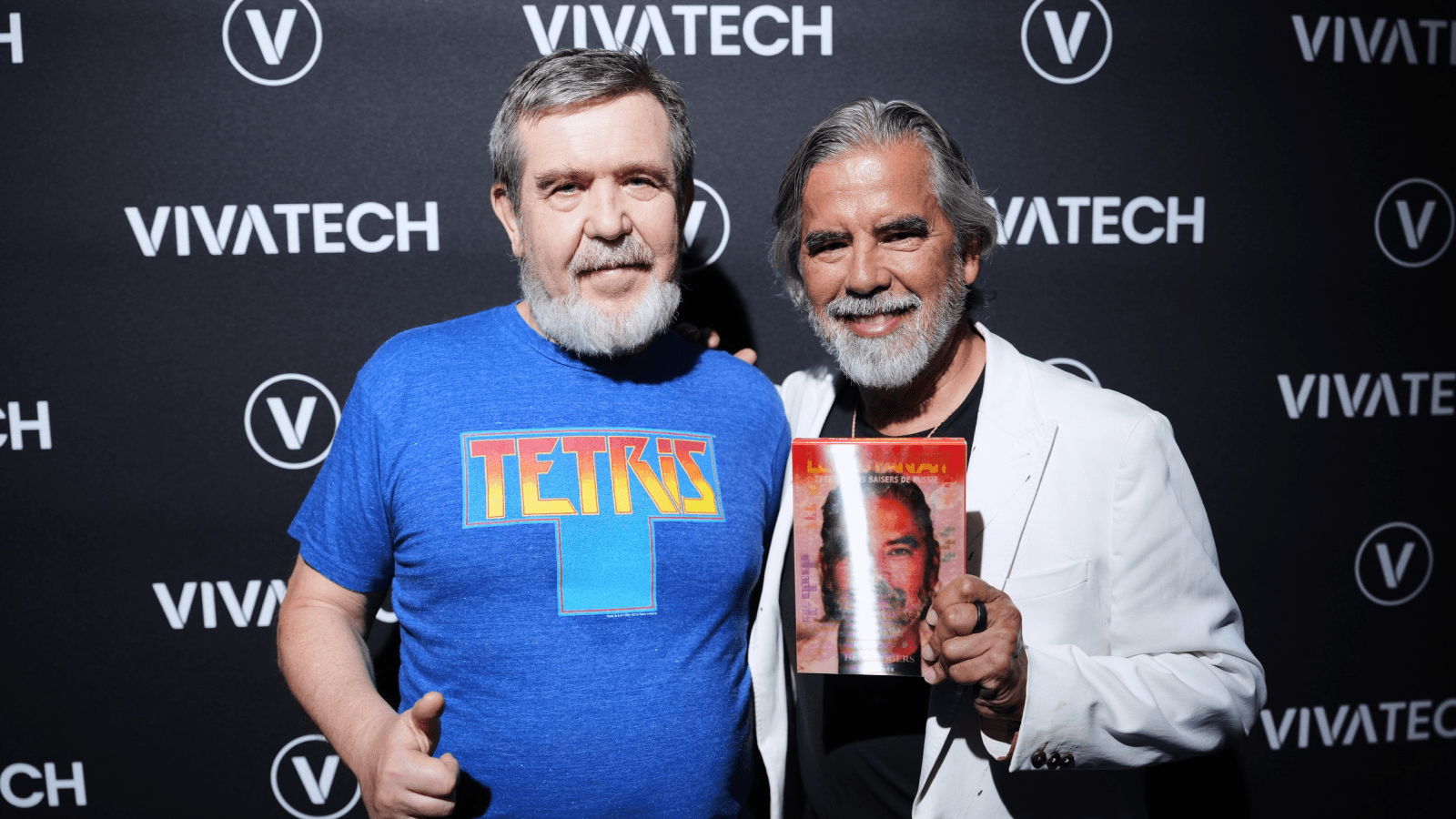
"No other game has lasted like Tetris has, and so I think this is the first virtual sport that's going to last in the future, like baseball, soccer, football." - Henk Rogers, Chairman of the Board, The Tetris Company.
VivaTech Day 3 brought the creator and the dealmaker of Tetris to the Theater stage, and Henk Rogers used his closing minutes to hold up his book, The Perfect Game. It is his own account of how a Soviet puzzle conquered the world, written because the 2023 Apple TV+ film invented an affair, a blackmail and a chase that never happened. Alexey Pajitnov sat beside him, the programmer who started it all in 1984.
Pajitnov explained that the game emerged from constraint. Working on a computer with no graphics or sound, he adapted the classic pentomino puzzle, reducing its 12 pieces to seven and making them fall in real time. The result became one of the most successful games in history.
Rogers discovered Tetris at the 1988 Las Vegas electronics show and became convinced it should be bundled with Nintendo's new Game Boy. Soon after, he flew to Moscow to untangle ownership rights in a country with no intellectual property law. The breakthrough came from an overlooked detail: Pajitnov had once entered Tetris in a computer competition and signed it with his name and a copyright notice, creating the only record of authorship. It ultimately helped him reclaim the rights, and in 1995 the two founded The Tetris Company.
Tetris is now being studied as a treatment for trauma and is moving through the NHS in England. Forty years after its creation, the falling blocks are still finding new uses.
Life After Search: What's Your Strategy When AI Becomes the Storefront?

"OpenAI has announced that they want to hit 100 billion dollars in five years' time. Very ambitious goal. So clearly they view advertising as a key way to monetize their LLMs." - Terry Kawaja, Chief Executive Officer and Founder, LUMA Partners
The discussion opened with a statistic. David Steinberg, founder and CEO of Zeta Global, said that a year ago 97% of Google searches sent users elsewhere, to a brand, retailer, or publisher. Today, he argued, 67% are answered directly on Google. Moderated by AdWeek CEO Will Lee, the panel explored what happens when both the answer and the storefront live inside the chat.
Terry Kawaja, founder of LUMA Partners, described the shift as a new hierarchy of value. Workflow becomes a commodity, decision-making powered by data becomes the differentiator, and large language models reshape discovery itself.
He argued advertising will follow intent, since a detailed prompt reveals far more than a traditional search query, and pointed to OpenAI's 00 billion revenue ambition as evidence that advertising is coming.
Steinberg built on that argument, describing Zeta as the first platform OpenAI has announced for serving ads into its model. But he cautioned that LLMs understand intent better than identity, knowing only a fraction of what Google knows about users.
Kirthiga Reddy, CEO of OptimizeGEO.ai, urged companies to measure their Generative Engine Optimization performance and cited a striking figure: even leading brands show zero visibility on roughly 40% of the queries they consider important.
The panel closed with a warning that AI search cannot be treated as an add-on. As Reddy put it, it is no longer the sprinkling on the fries; it is the main ingredient.
Stage Panorama
Black Stage
This morning VivaTech’s Black Stage focused on Energy, GreenTech, and Mobility and the future of sustainable, durable urban transportation.
- Key Session: Shared Roads, Shared Vision: Data Powering the Next Generation of Urban Mobility, from designing systems to balancing financial foundations, with Nicolas Besombes (Université Cité Paris), Julie Jeanniot (Riot Games), Catherine Martel (Haus of Park), and Jérémy Somville (Ubisoft).
Pivoting to Creative Industries in the afternoon, sessions were geared towards art, retailers, and the ongoing debate of who owns the content; creator or platform?
- Key Session: Players First, Business Always: The Gap Between What Players Need and What Industry Sustains, from designing systems to balancing financial foundations, with Martin Calmels (Geopost Vision), Jean-Philippe Duval (PwC), Clémentine Flinois (Clem’), David Monteau (Métropole du Grand Paris), and Brooks Patrick (Esri).
Red Stage
The Red Stage spent the morning focusing on cybersecurity and defense as cyber threats grow in scale and sophistication, governments are rethinking their approach.
- Key Session: From Adversaries to Assets: When Hackers Shape National Security, from public to private cyber security, with Nicole Carignan (Darktrace), Dakota Cary (SentinelOne), Christopher Porter (Google), and Jennifer Schenker (The Innovator).
The Red Stage closed on investment, exploring the 3 pillars: Risk, Build, Scale.
- Key Session: Stay or Scale: Where Should Europe’s Startups Grow?, asking if Europe should anchor its startups locally, or embrace global expansion, with Michelle Bourgeois (PwC), Zuzanna Czapinska (ICONIQ), Julien Launay (Adaptive ML), and Julien-David Nitlech (IRIS).
Purple Stage
Purple Stage’s morning sessions were discussing Productivity Reimagined and the intricacies of how AI can work for you and go further than everyday manual usage.
- Key Session: Bringing AI Beyond the Screen: Making Intelligence Disappear Into Daily Life, from doorbell cameras to low-earth orbital satellites, with Panos Panay (Amazon), and Alexandra York (Forbes).
The stage closed on sovereignty and ethics, when the sheer volume of information is overwhelming, truth becomes an even more valuable commodity.
- Key Session: The Business of Telling the Truth: Journalism in the AI Era, discussing the sheer volume of information in the modern day, with Bill Adair (Duke University), Louis Dreyfus (Groupe Le Monde), Alex Hardiman (New York Times), and Steven Levy (Wired).
Don’t Miss the Festival Day!
Tomorrow, we'll open our doors to the general public, and there is still time to get your pass. Follow the latest announcements and highlights on Instagram, TikTok, and LinkedIn. And if you’re sharing your own experience, tag @VivaTech and use #VivaTech so we can follow along with your journey at Europe’s biggest startup and tech event.