Cybersecurity is a constant race between attackers and defenders, and artificial intelligence has accelerated the pace. Attackers use AI to scale and advance their tactics, while organizations use AI threat detection to respond faster than ever before.
“As with any tool, it can be used by the good guys, and it can be used by the bad guys,” explains Guy-Philippe Goldstein, a cyber warfare analyst and strategic advisor at Expon Capital.
With attack volumes surging and tactics becoming more sophisticated, businesses are turning to AI threat detection for speed and scale that human teams alone can’t match.
What is AI threat detection?
AI threat detection is the use of machine learning and advanced algorithms to analyze large datasets and identify potential security threats. Traditional cybersecurity tools rely on known attack signatures, but AI threat detection systems can detect patterns and unusual behavior across networks, devices and users.
These AI threat detection systems also continuously learn from new data, so they can adapt to emerging threats and improve over time. This makes AI threat detection particularly useful against threats that evolve faster than traditional cybersecurity systems can keep up.
Why traditional security tools are no longer enough
The limits of signature-based detection
Traditional cybersecurity tools depend heavily on signature-based detection, meaning threats are identified based on known patterns of malicious activity. While this method is effective for known malware, it struggles to protect against new or modified attacks.
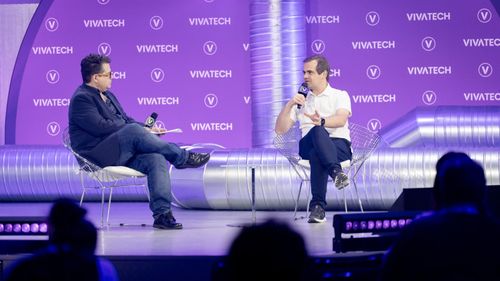
“Somebody has to get hacked first, and then all the threat intel companies work out what happened and share the information with everyone else so we can learn from somebody else's mistake,” explained Toby Lewis, Head of Threat Analysis for the cybersecurity platform Darktrace, at VivaTech 2025. “We can't keep doing that, and that's not a pace we can maintain.”
Cybercriminals now deploy dangerous attack tactics such as polymorphic malware, fileless attacks and sophisticated phishing campaigns that can easily get through traditional detection systems. This means that relying only on predefined signatures leaves organizations exposed.
How attack volumes have outpaced human analysis
The scale of today’s cyber threats is staggering. There can be thousands of attacks on a company daily, and security teams are faced with an overwhelming volume of alerts.
“Since the launch of ChatGPT the number of attacks has grown by more than a thousand percent,” says Benjamin Netter, founder of employee cybersecurity company Riot. “And the scale of the attacks are very different and they are much more sophisticated than before.”
Human security analysts simply cannot process this volume in real time. But AI threat detection can turn data overload into actionable intelligence by automating detection, prioritizing risks and enabling faster response times.
How AI threat detection actually works
Behavioural anomaly detection and baseline modelling
At the core of AI threat detection is behavioral analytics. Systems establish a “baseline” of normal activity across users, devices and networks. Any deviation from this baseline – such as unusual login times or abnormal data transfers – triggers an alert.
Using this method, AI threat detection can identify attacks that have never been seen before, including insider threats and zero-day exploits.
Machine learning, deep learning, and real-time response
AI threat detection systems use a combination of machine learning and deep learning models to process huge datasets in real time. These systems can:
- Analyze network traffic and user behavior
- Identify patterns linked with malicious activity
- Continuously refine detection models
- Automate responses to reduce risk
Unlike traditional cybersecurity tools, AI threat detection can also instantly respond to attacks, isolate compromised systems or block suspicious activity.
The threats AI detection systems are built to catch
Malware, phishing, and ransomware
AI is excellent at detecting common but evolving threats such as:
- Malware variants that evade signature detection
- Phishing campaigns that mimic real communication
- Ransomware attacks that spread rapidly across systems
By analyzing behavior instead of static indicators, AI can identify these threats earlier in the attack lifecycle and reduce the damage.
Insider threats and zero-day attacks
Some of the most dangerous cybersecurity threats come from within. Insider threats are when employees intentionally or accidentally misuse their access, allowing for data to be stolen.
Insider threat data breaches are difficult to detect using traditional tools. But AI can identify subtle behavioral changes that may signal a compromised account or insider risk, such as unusual access patterns or data movement.
AI threat detection also plays a critical role in identifying zero-day attacks – software security holes unknown to developers and with no existing signatures.
AI threat detection in critical infrastructure
From healthcare systems to energy grids, critical infrastructure is increasingly reliant on connected technologies. This makes it a prime target for cyberattacks.
AI threat detection helps protect these systems by:
- Monitoring real-time activity across environments
- Detecting irregularities in operational technology (OT) systems
- Preventing disruptions that could have real-world consequences
Government, financial or healthcare database breaches can put millions of people at risk of having their most sensitive data used against them. It is essential that these organizations use the most modern cybersecurity systems available to prevent breaches.
The risks of relying on AI detection alone
False positives, alert fatigue, and model bias
AI is powerful, but not without limitations. Poorly trained models can generate false positives and overwhelm security teams with unnecessary alerts.
There’s also the risk of bias in training data, which can impact detection accuracy and create blind spots in security systems.
Why human oversight remains essential
AI is a tool and shouldn’t be used as a replacement for human expertise. Security analysts play a critical role in:
- Interpreting AI-generated alerts
- Making strategic decisions
- Investigating complex threats
- Ensuring ethical use of AI systems
The most effective cybersecurity defense is a hybrid model that combines AI automation with human judgment.
How businesses can implement AI threat detection
Organizations wanting to adopt AI threat detection should take the following steps:
- Assess current security infrastructure and identify risks
- Integrate AI with existing systems
- Adopt a layered security strategy
- Train teams to work alongside AI tools
- Continuously monitor and refine cybersecurity models
Frameworks like the zero-trust cybersecurity model can be combined with AI to strengthen a company’s defenses.
What comes next for AI threat detection
Looking ahead, key trends in AI threat detection include:
- Autonomous security systems that respond without human intervention
- Predictive threat intelligence
- Integration with emerging technologies such as quantum computing
- Even more sophisticated use of AI by attackers
“We will have to do more and more automation,” said Olivier Nautet, Chief Information Security Officer for BNPP Group, when asked about the future of AI and cybersecurity on the VivaTech stage. “Humans will not be able to work 24 hours per day managing terabytes of data. People are there to define the processes, but not to deploy them. That should be done by automatic processes.”
For businesses and organizations, the takeaway is clear: AI threat detection is no longer optional. It is a critical component of cybersecurity strategy and companies using it effectively will be best positioned to stay ahead of the threats.
Want to hear global leaders in AI and cybersecurity discuss the future of AI threat detection? Join us at the next edition of VivaTech!