Alongside the AI race to build the best model, there’s also the race to fund, scale, and commercialize AI businesses. While Europe produces world-class AI research, top engineering talent, and a strong startup ecosystem, the Europe AI funding gap is a clear challenge.
It isn't as simple as Europe versus the United States. European startups are increasingly competitive in the early stages, but struggle to secure the growth capital needed to become global AI leaders.
As a result, founders can face a difficult decision: continue building from Europe or look overseas for the funding required to scale.
How Big Is Europe's AI Funding Gap Right Now
One of the biggest misconceptions about Europe's startup ecosystem is that founders can't raise capital. But it’s not until later funding stages that the gap really grows.
Early-Stage Funding Is Close, Late-Stage Funding Is Not
Europe's early-stage funding environment has matured significantly over the past decade. Seed and Series A rounds have become increasingly competitive, supported by a growing network of angel investors, venture capital firms, accelerators, and public funding programs.
The challenge begins when startups reach Series B, C, and beyond. That’s when the funding gap between Europe and the US widens dramatically. While American AI companies routinely secure mega-rounds worth hundreds of millions of dollars, European startups often struggle to find investors willing to make similarly ambitious bets.
US investors dominate AI venture capital investment, putting in roughly 24 billion in 2025—that's 56% of all global VC investment in AI. The entire EU27 combined invested just $14.5 billion, or 7% of global investment.
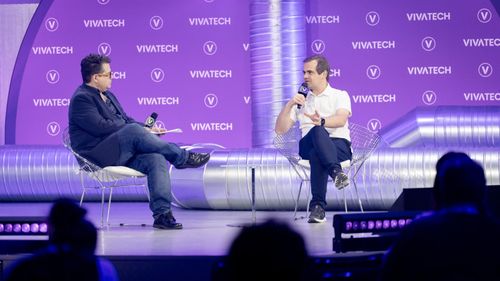
"We don’t lack the brains in Europe,” said German entrepreneur and angel investor Alexander Diehl at VivaTech 2026. “But we haven't built the muscle, the venture muscle to really go and foster deep tech innovation."
For founders, this creates a dilemma: continue raising smaller rounds over a longer period, or relocate closer to the investors capable of funding global expansion.
Where US Capital Is Filling the Gap
The shortage of late-stage funding doesn't necessarily mean European startups stay underfunded. Instead, many increasingly turn to US investors.
American venture capital firms and tech giants are major backers of Europe's fastest-growing AI companies. For example, Microsoft committed to a multibillion dollar partnership with French AI company Mistral to expand infrastructure in Europe.
While this provides founders with access to significant capital, it can also influence where companies establish headquarters, hire executives, or eventually list on public markets.
This funding reality reflects the global nature of AI entrepreneurship. Capital can cross borders, while talent, research, and product development may still stay rooted in Europe's technology hubs.
What's Driving the Gap Between Europe and the US
The funding gap is not only about money. It's also about investment culture.
A More Cautious Culture Around Risk Capital
US venture capital has traditionally rewarded rapid growth, accepting higher levels of risk in exchange for potentially creating category-defining companies. Investors are often willing to support ambitious business models long before profitability, particularly in sectors like artificial intelligence where market leadership can develop quickly.
European investors have historically taken a more conservative approach, placing greater emphasis on sustainable growth, revenue, and capital efficiency. This discipline can produce more resilient businesses, but it can also limit the number of startups capable of scaling at the pace required in today's AI market.
The result is an ecosystem where companies may need to prove themselves before receiving substantial investment, while US competitors receive larger funding earlier to fuel aggressive expansion.
A Fragmented Market Across 27 Countries
Unlike the United States, Europe is not one unified market. Founders building across the European Union have to navigate different languages, regulations, tax systems, labor laws, and customer preferences.
This fragmentation can influence investor confidence. Venture capital firms often evaluate how quickly startups can achieve market scale, and companies operating across multiple regulatory environments may face longer sales cycles and higher operational costs.
Still, Europe continues to produce exceptional AI research, deep-tech innovation, and engineering talent. The challenge is creating an environment where companies can grow into global leaders without leaving the continent.
How Europe Is Moving to Close the Gap
Instead of debating whether Europe can compete, policymakers and investors are increasingly focused on building the infrastructure needed to help AI companies scale.
“On AI, we're catching up,” Roland Lescure, France’s Minister for the Economy, Finance and Industrial and Energy Sovereignty, told the VivaTech audience. “True to say, the US and China are ahead. But there's enough strength and potential capabilities in Europe so that we can catch up."
Inside the EU's €200 Billion InvestAI Initiative
Public investment is becoming a bigger part of Europe's AI strategy. The European Commission's €200 billion InvestAI initiative was established to strengthen the continent's AI ecosystem by mobilizing both public and private capital.
It aims to fund more startups, but also create the conditions for companies to scale without immediately looking abroad.
The initiative supports everything from AI infrastructure and research to commercialization, helping bridge the gap between academic breakthroughs and market-ready products. And while government funding can’t replace venture capital, it can reduce early risk, attract institutional investors, and encourage larger private investment rounds.
AI Factories, Gigafactories, and Public-Private Capital
Capital is only one piece of the puzzle. Access to computing power has become just as important.
"The biggest issue on European compute is that energy, building permits, and the cost of actually running a data center in Europe is 20% to 30% higher than it is in the U.S,” explains Cedrik Neike, CEO of digital industries at Siemens. “We have to find a way to go around this."
This need is pushing Europe investment in AI factories and next-generation computing infrastructure, giving startups and researchers greater access to the high-performance computing needed to train and deploy advanced AI models. Along with public-private partnerships, these initiatives are designed to lower barriers for startups developing frontier AI technologies.
What the Gap Means for European AI Startups
For many founders, choosing where to raise capital is becoming a strategic decision more than a geographical one.
Raising at Home Versus Raising in the US
European investors often bring deep market knowledge, local networks, and long-term relationships.
US investors may offer larger rounds, stronger connections to global technology markets, and experience scaling companies internationally.
Increasingly, startups are combining both. A company may secure its early funding from European venture firms before bringing in US growth investors to finance international expansion. This hybrid approach lets founders keep engineering and product teams in Europe while still accessing the capital needed to compete globally.
Why Some Founders Choose to Relocate or Dual-Base
Relocating to the United States doesn’t always mean leaving Europe behind.
Many AI startups now operate with a dual-base model, keeping research, engineering, and product development in European cities while establishing commercial headquarters in New York, San Francisco, or other US innovation hubs. This setup gives companies access to customers, investors, and partnerships without abandoning Europe's talent pool.
Others choose to remain entirely European, arguing that remote work, global customers, and international investors have made location less important than execution.
Ultimately, founders optimize for growth, not geography.
Building Lean to Outlast a Tighter Market
Europe's funding environment has also encouraged a different business mindset. Instead of prioritizing rapid expansion at all costs, many European startups are focused on efficient growth, sustainable business models, and disciplined capital allocation.
These habits could prove valuable in the future as global investors place greater emphasis on profitability and long-term resilience.
The current AI market has also prompted founders to question whether every company needs billion-dollar funding rounds to succeed. The companies creating lasting value won't necessarily be those that raise the most money—they'll be the ones building products customers genuinely need.
A Risk, Build, Scale Framework for Founders
The funding gap is real, but it shouldn't automatically dictate where founders build.
Weighing the Real Risk of Staying in Europe
Europe offers exceptional universities, leading AI researchers, established industrial partners, and growing public investment. Many Europe-based startups can validate products, attract customers, and build strong businesses before seeking larger international funding rounds. Instead of asking whether Europe is "good enough," founders should think about where they can access the customers, talent, infrastructure, and capital that best fit their stage of growth.
What It Takes to Build and Scale From a European Base
Scaling from Europe increasingly requires thinking globally from day one.
This means designing products for international markets, building relationships with investors beyond national borders, and taking advantage of Europe's expanding network of accelerators, research institutions, and innovation ecosystems.
Events like VivaTech that connect startups with global investors and enterprise partners can also help close the visibility gap.
So, Is the Gap a Risk or Room to Scale?
Closing Europe's AI funding gap involves more than larger investment funds.
What Would Need to Change
Tackling the AI funding gap requires Europe to:
- Encourage greater risk tolerance among investors
- Create deeper pools of late-stage capital
- Simplify cross-border growth
- Invest even more in world-class AI infrastructure
- Foster stronger collaboration between governments, institutional investors and corporations
- Increase venture capital firm investment
Just as importantly, Europe needs to continue backing founders after their first breakthrough—not only helping companies launch, but helping them become global category leaders.
Why the Opportunity Is Still Wide Open
The AI race is still in its early chapters. The funding gap remains one of Europe's biggest competitive challenges, but it is also one of its biggest opportunities.
The next stage hasn't even started,” said Lescure. “So there's no reason why we shouldn't be on the front of the races that are still ahead. But if we don't find funds to make sure that the innovations that are going to be invented are becoming reality, then we're not going to win that race.
Europe already has the ingredients needed to build globally competitive AI companies: exceptional research, highly skilled talent, respected universities, and a vibrant startup ecosystem.
Now the challenge is making sure that promising European AI startups can access the capital required to scale without having to look overseas.
For more on the future of AI funding, read this next: Investing in AI: What VivaTech 2026 Revealed About the Next Wave of Growth