Key takeaways |
|---|
|
Advertising has always evolved alongside new technology, and AI is the latest innovation to shake up the industry.
Nearly half of consumers now use AI to search for products, discover brands, and shop online.
At the same time, the use of AI in advertising is changing how marketers work by automating repetitive tasks and allowing for faster, more personalized campaigns.
Why AI Is Forcing a Reckoning in Advertising
Few technologies have spread across marketing departments as quickly as generative AI.
How Fast AI Is Moving Through Advertising
Within just a few years, tools capable of writing headlines, generating images, editing video, analyzing audiences, and optimizing media spend have become accessible to businesses of every size.
For advertisers, the appeal is obvious. Campaign development that once took weeks of research, brainstorming, production, and testing can now happen in days—or even hours. This drastic reduction in production time allows marketers to experiment with more creative options.
What's Driving the Shift Right Now
First, consumers generate more digital data than ever before. This allows marketers to use AI insights to understand purchasing behavior, predict customer intent, and deliver more relevant messaging.
Second, economic pressure is forcing marketing teams to do more with fewer resources. AI helps automate repetitive production tasks, freeing up creatives to focus on strategy, storytelling, and brand building.
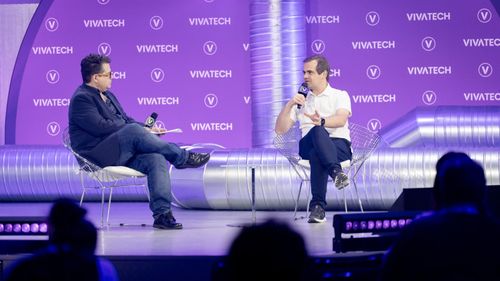
Third, consumers now expect personalized experiences, as Shantanu Narayen, chairman and CEO of Adobe, said at VivaTech 2026: "Every single company on the planet is now recognizing that their success depends on engaging with customers across all channels in an incredibly personalized way." AI lets brands create thousands of tailored creative assets for different demographics, behaviors, and purchasing journeys.
Finally, the quality of the technology itself is driving this shift. Today's generative AI models can produce sophisticated text, images, audio, and video, making them practical tools for real advertising campaigns.
Where AI Is Disrupting the Old Advertising Model
AI's impact is highly visible inside creative agencies.
Creative Work and the Changing Role of Agencies
AI is not replacing creativity in advertising, but becoming a creative collaborator.
Traditionally, advertising agencies built campaigns using long creative processes involving copywriters, designers, strategists, production teams, and external studios. While those roles are still needed, AI is changing how they work together.
Instead of starting from a blank page, creative teams can use AI to generate concepts, explore multiple visual directions, draft campaign copy, or produce first-round storyboards. This allows teams to move more quickly through early ideation and spend more time refining the ideas that resonate.
Creatives are now saying, how can I use different modalities?,” explained Narayen. “How can I automate inefficient production processes? And how can I use AI to make sure that my brand and my personal design aesthetic is well represented?Creatives are now saying, how can I use different modalities?,” explained Narayen. “How can I automate inefficient production processes? And how can I use AI to make sure that my brand and my personal design aesthetic is well represented?
New Pressure on Traditional Skills and Roles
That doesn't mean job disruption isn't real.
Many of the production tasks that were handled by junior designers, copywriters, and marketing teams can now be completed in minutes with AI tools.
This has led employers to increasingly look for professionals who can combine creative judgment with technical fluency—people who know how to prompt AI effectively, evaluate outputs critically, interpret data, and develop strategies that align with brand objectives.
Where AI Is Opening Up the Industry's Next Leap
If disruption is one side of AI's story, personalization is the other.
Faster, More Personalized Creative at Scale
Today’s consumers expect brands to understand their preferences, without feeling intrusive of their privacy. AI helps marketers achieve this tricky balance by creating highly relevant experiences based on customer behavior, interests, location, and engagement history.
Instead of building one campaign for millions of people, advertisers can create thousands of variations tailored to different audiences, platforms, and moments in the customer journey.
This can be expressed in:
- Copy and imagery
- Product recommendations
- Adjusted messaging
- Optimized media buying
- Personalized email campaigns
- Localized creative for global markets
All of this can be achieved while also using AI insights to understand which approaches deliver the strongest performance.
New Formats and New Revenue Opportunities
AI is powering entirely new forms of advertising and ways for brands to engage consumers, such as:
- Interactive experiences
- Conversational commerce
- AI-powered shopping assistants
- Virtual influencers
- Synthetic video
- Personalized content recommendations
As generative AI is increasingly embedded into search engines, creator platforms, retail experiences, and enterprise software, advertising is becoming more dynamic and context-aware.
Inside Real Campaigns Already Making the Leap
Major global brands are moving beyond AI experimentation in their advertising and into real-life impact.
Generative AI in Major Brand Campaigns
Companies including Coca-Cola, Heinz, Nestlé, and Unilever have all incorporated generative AI into creative development, content production, or marketing campaigns.
Some brands use AI to accelerate internal creative workflows, while others have put AI-generated visuals and storytelling directly in front of consumers, with mixed results.
When creative processes or advertisements lean too heavily on AI, brands have learned the hard way that consumers can have a negative emotional response.
Inside Real Campaigns Already Making the Leap
AI campaigns are a high-risk, high-reward endeavor.
Generative AI in Major Brand Campaigns
Coca-Cola was an early adopter of AI in advertising. Back in 2023, the brand invited digital creatives to use a first-of-its-kind AI platform to generate original artwork using archival Coca‑Cola creative assets. The brand displayed some creations on digital billboards in New York’s Time Square and London’s Piccadilly Circus, generating a collaborative moment with fans and artists.
But Coca‑Cola was less successful with an 2024 AI-generated Christmas video meant to pay homage to a classic 1995 Coca-Cola commercial. The video was met with public outrage over the use of technology to replace artists and real actors.
Heinz found success using AI in advertising by leaning into the fact that the images were created by artificial intelligence. The company prompted image-generation models to “draw ketchup” and discovered that AI consistently produced bottles resembling Heinz's signature design. The resulting campaign cleverly showcased the brand's cultural recognition while also demonstrating the capabilities (and limitations) of generative AI.
What These Early Bets Are Teaching the Industry
Successful use of AI in advertising shares several common themes.
First, AI works best when coupled with strong human oversight. Brands getting the most positive reactions aren't handing campaigns over to algorithms, but using AI to accelerate ideation and execution while keeping people in charge of strategy, quality, and brand consistency.
Second, companies are finding that speed creates competitive advantage. Marketing teams can now respond to trends in hours rather than weeks, quickly generate localized creative for international markets, and test campaign variations continuously instead of waiting until after launch.
Finally, early adopters of AI in advertising are learning that governance matters just as much as innovation. Clear approval processes, brand guidelines, legal review, and transparency policies are essential when AI-generated assets represent a brand.
Building Trust as AI Scales Across Advertising
Savvy consumers are asking questions about AI-generated advertising. For brands, maintaining their trust is a defining challenge of the AI era.
Authenticity, Trust, and Ad Disclosure
Consumers tend to care less about whether AI was used to produce an advertisement than whether the ad feels honest, useful, and authentic.
That said, research shows that the majority of consumers feel manipulated when brands don’t disclose the use of AI in their advertising. Some companies voluntarily label AI-generated content, while others disclose AI use only in situations where consumers could get confused.
Adobe CEO Shantanu Narayen supports transparency when it comes to AI in advertising: "When you have a piece of food, you have a nutrition label. So why not use technology to have a nutrition label or a piece of meta data, that goes with every piece of content?”
Transparency generally leads to stronger consumer confidence. Brands using AI in their creative process should remember that trust takes years to build and only moments to lose.
Navigating the Ethics of AI-Generated Content
AI models are trained on enormous datasets, and there are ongoing questions around copyright, creator compensation, bias, misinformation, and ownership.
When Adobe was developing its GenAI models, protecting copyright and creative ownership was a major consideration. "Can we make sure that we design an image model, a video model that has been designed to be commercially safe and respects intellectual property?,” said Narayen. “That has been really important to us because we cannot just scrape the Internet and violate the trust and the confidence that creatives have in us."
Companies also need AI safeguards to prevent inaccurate claims, offensive outputs, or content that reinforces stereotypes.
AI ethics shouldn’t be treated as a legal checkbox, but incorporated into campaign development from the beginning.
Regulation and Compliance
Global brands have to follow guidelines across international jurisdictions and stay informed on evolving regulations.
In Europe, the AI Act introduces risk-based rules governing certain AI systems, while consumer protection laws apply to misleading advertising regardless of whether humans or AI created the content.
Meanwhile, policymakers in the United States and United Kingdom have different approaches to AI oversight, creating a complex compliance landscape for multinational brands.
So, Is It Disruption or the Industry's Next Leap?
Unquestionably, AI has a huge impact on traditional advertising workflows. "This is a disruptive time,” says Narayen. “Those who ignore the technology definitely run the risk of having the technology pass them by."
But disruption doesn't mean decline. AI appears to be pushing advertising toward a more strategic, data-driven, and creative future.
What the Data Says So Far
According to Salesforce’s State of Marketing 2026 report, 87% of marketers now use generative AI in at least one recurring workflow.
Companies and agencies report improvements in content production speed, campaign optimization, audience targeting, customer insights, and operational efficiency.
Instead of reducing headcount, many teams are reinvesting the time saved into strategy, experimentation, and creative development.
What It Takes to Turn Disruption Into a Leap Forward
The brands most likely to succeed with AI in advertising won’t use it as a replacement for creativity. Instead, they'll build processes in which AI handles repetitive tasks while people focus on empathy, storytelling, cultural understanding, and long-term brand building.
The role of technology is to augment human creativity and not to replace it,” insists Narayen. “The real piece of content that stands out, the real customer brand that will stand out, will combine that uniquely creative process with the emotional process of creating engagement. I’m a fan of technology. I think we have to embrace it. But we have to recognize that human ingenuity at the end of the day is all that matters.
From television to search, social media to mobile, technology has always shaped advertising. While AI tools are changing the process once again, what will never change is the importance of human creativity and creating messages that resonate.
FAQs |
|---|
Is AI really disrupting the advertising industry?Unquestionably, AI has a huge impact on traditional advertising workflows. But disruption doesn't mean decline. AI appears to be pushing advertising toward a more strategic, data-driven, and creative future. |
How is AI changing creative jobs in advertising?The use of AI in advertising is changing how marketers work by automating repetitive tasks and allowing for faster, more personalized campaigns. Campaign development that once took weeks of research, brainstorming, production, and testing can now happen in days—or even hours. |
Do brands have to disclose when an ad is AI-generated?The United States, United Kingdom, and European Union all have different regulations, making compliance complicated for multinational brands. However, research shows that the majority of consumers feel manipulated when brands don’t disclose the use of AI in their advertising. |
Are there any regulations on the use of artificial intelligence in advertising?In Europe, the AI Act introduces risk-based rules governing certain AI systems, while consumer protection laws apply to misleading advertising regardless of whether humans or AI created the content. Individual platforms such as Instagram, TikTok, or Pintrest may have their own rules and regulations or use of AI content that brands need to follow. |
Will AI replace creative marketing teams?AI is not replacing creativity in advertising, but becoming a creative collaborator. Employers are increasingly looking for professionals who can combine creative judgment with technical fluency—people who know how to prompt AI effectively, evaluate outputs critically, interpret data, and develop strategies that align with brand objectives. |